TL;DR (For Practice Owners)
If April was about laws getting passed, May was about the rules getting written and the market deciding who it still wants to buy.
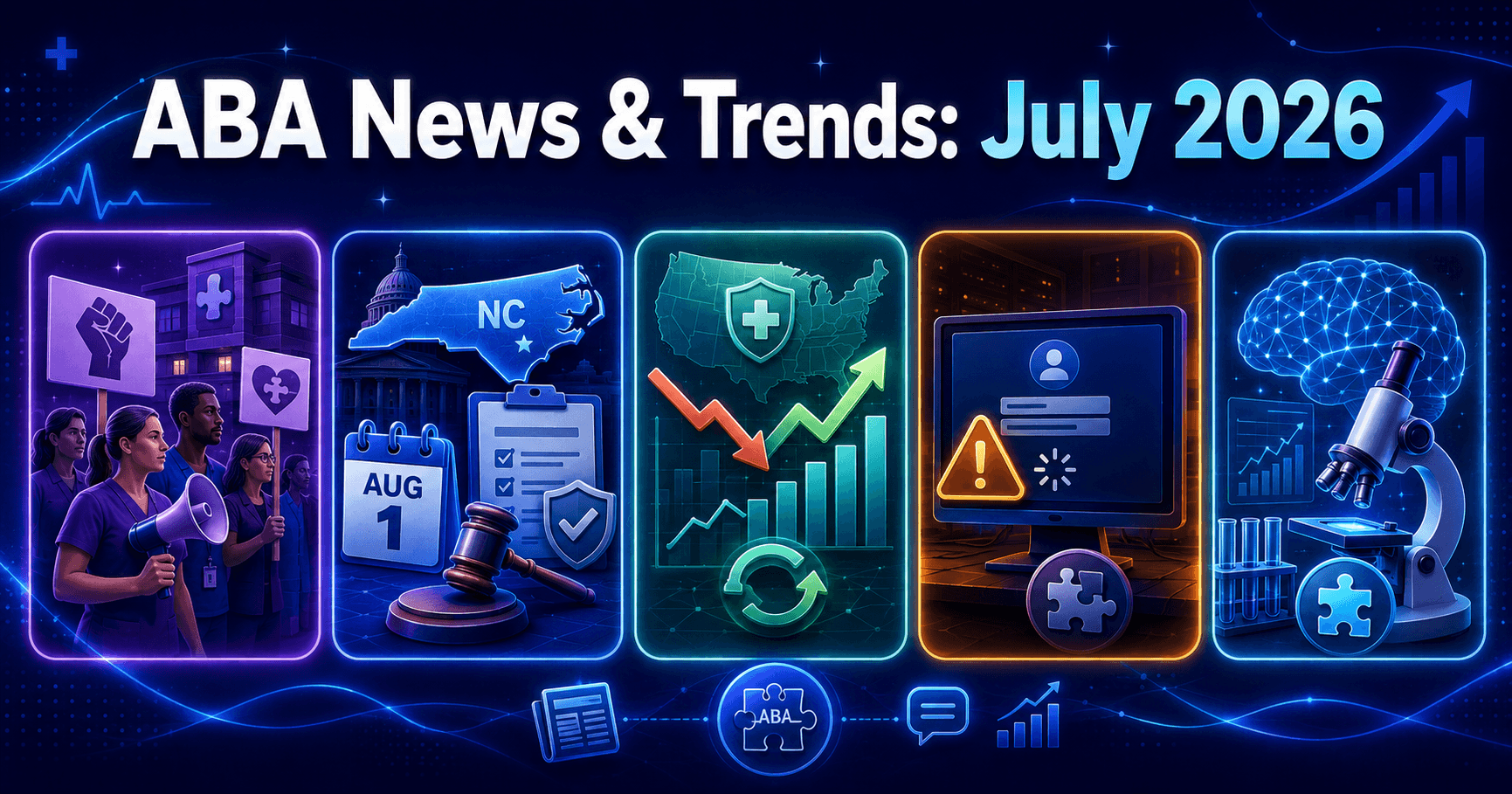
- North Carolina moved from law to rulebook. Governor Stein signed HB 696 on April 30, and on May 14 the state's Medicaid agency released its draft rewrite of Clinical Coverage Policy 8F, the actual operating rules for ABA. The comment window runs through June 14. The bill was the headline. The draft policy is where your day-to-day gets decided.
- Indiana stopped letting new providers in. On May 7, Indiana Medicaid announced it's seeking federal approval to freeze new ABA group enrollments and changes of ownership for six months starting June 6. If you're buying or selling an Indiana agency, your timeline just changed.
- CareSource Georgia's 20% cut went live. The Medicaid MCO's reduction to 80% of the state fee schedule took effect May 11. The objection window has closed. Providers who stayed are now operating at the new rate.
- M&A came back, but only for clean assets. FullBloom sold Little Leaves to LEARN Behavioral on May 11, and Behavioral Framework added Autism ETC. Dealmakers are calling it a flight to quality. Well-documented practices are trading at real valuations. Distressed roll-ups are not.
- The workforce story grew up. The framing shifted from "shortage" to "durability." Roughly 30,000 BCBAs work in direct clinical service against an estimated 100,000 needed, and 46% of U.S. counties still have no BCBA at all.
Here's what actually matters right now if you're running an ABA practice.
Want the full picture? Read our State of ABA Therapy 2026 for market data, workforce trends, billing benchmarks, and outlook for independent practice owners.
Industry News
The closure-and-cut headlines didn't stop in May, but the more telling story was what dealmakers did with their money. After two slow years in 2022 and 2023, autism services M&A came back through 2025 and into 2026, and it came back picky.
The Flight to Quality Is Real
On May 11, LEARN Behavioral, backed by Gryphon Investors, acquired Little Leaves Behavioral Services from FullBloom. Little Leaves runs 18 center-based ABA programs across Maryland, Virginia, and Florida, serving children ages 1 to 6. The deal pulled FullBloom out of direct ABA delivery entirely, redirecting it toward K-12 education and school-based mental health, and it put LEARN in Florida for the first time.
What makes this deal worth your attention isn't the dollar figure. It's the type of asset. Little Leaves is a clean, reputable early-intervention group with a defined geographic footprint, not a distressed chain getting absorbed at a discount. Industry analysts described the 2026 market as a flight to quality, and the Little Leaves sale is the template: buyers want documentation discipline, clinical reputation, and operational clarity, and they'll pay for it. The same week, Behavioral Framework expanded into new markets by adding Autism ETC, backed by Renovus Capital. Early June brought news that the Apara Autism platform had hit the auction market.
The lesson for independent owners is uncomfortable but useful. If you've ever thought about an exit, the gap between what a clean practice fetches and what a messy one fetches has never been wider. The practice management software you run isn't just an operations tool anymore. The data hygiene it enforces is part of your enterprise value. IDD services set a record with 31 deals in 2025, and autism deals followed closely. Capital is available. It's just selective about where it lands.
Read more:
- Behavioral Health Business: FullBloom Sells Little Leaves Behavioral Services to LEARN Behavioral
- Behavioral Health Business: 'We'll See a Big Flight to Quality,' What's Driving Autism Services Dealmaking in 2026
- Behavioral Health Business: Autism Therapy Platform Apara Autism Hits Auction Market
Legislation and Regulatory Updates
April was the month the big bills passed. May was the month the agencies started turning those bills into rules you actually have to follow, and the difference matters more than it sounds.
North Carolina: From Law to Rulebook
Governor Josh Stein signed HB 696 into law on April 30, providing roughly $320 million to cover rising Medicaid costs and handing the Department of Health and Human Services new tools to manage ABA. That was the part everyone saw coming. The part that determines your workflow arrived on May 14, when DHHS published draft revisions to Clinical Coverage Policy 8F, the section of state Medicaid rules that governs how ABA is actually delivered and paid.
The draft tightens provider oversight, restricts telehealth for assessments and treatment, and adds accountability standards. Public comments are open through June 14, which means anyone operating in North Carolina has a narrow window to read the draft and respond before it locks in. The cost pressure behind all of this is steep: North Carolina's ABA payments were $122 million in fiscal 2022 and are projected to hit $639 million in fiscal 2026, a 423% increase in four years. The legislature treated that curve as a runaway program, and the rulebook reflects it.
If you serve North Carolina Medicaid, don't wait for the final policy. Read the 8F draft now and submit a comment if any provision would break your model.
Indiana: The Door Closes to New Entrants
Indiana spent April implementing its overhaul. In May, it moved to stop new providers from entering the market at all. On May 7, the Indiana Health Coverage Programs announced it's seeking CMS approval for a statewide moratorium on new ABA therapy group enrollments and changes of ownership, beginning June 6 and lasting at least six months, extendable in six-month increments. Applications received before June 6 and requests to add rendering providers are excluded.
The trigger was a federal audit estimating Indiana improperly paid roughly $56 million for ABA services. That sits inside a spending story that's hard to argue with: Indiana's Medicaid ABA payments rose from about $21 million in 2016 to $611 million by 2023. Layer the moratorium on top of April's 6% rate cut, the 4,000-hour lifetime cap, and the CASP accreditation requirement coming in October 2027, and Indiana has effectively frozen its provider market while it sorts out who belongs in it. For anyone planning to buy or sell an Indiana agency, a change of ownership has to close before June 6 or wait out the freeze.
State Spotlight
| State | Update | Impact | Status |
|---|---|---|---|
| North Carolina | HB 696 signed April 30; draft Clinical Coverage Policy 8F released May 14 (telehealth limits, tighter oversight) | The operating rules are being written now; providers have until June 14 to comment | Comment period open |
| Indiana | Seeking CMS approval for a 6-month freeze on new ABA group enrollments and changes of ownership | Halts new market entry and agency sales starting June 6; tied to a $56M improper-payment audit | Pending CMS approval, June 6 start |
| Georgia | CareSource Medicaid MCO cut reimbursement to 80% of the state fee schedule | 20% effective rate cut now operational; objection window closed | Live since May 11 |
| Colorado | OIG audit finalized $77.8M in improper payments; ABA spend reached $230.3M by 2024 | 283% spending growth since 2019; recoupment and oversight pressure | Audit released |
| Maine | OIG audit found $45.6M in improper payments ($28.7M federal share) | Federal recoupment required; documentation failures across sampled months | Audit released |
| Federal | HHS-OIG committed to nine state audits; House Energy & Commerce probing 10+ programs | Documentation discipline is now baseline, not a differentiator | Ongoing |
The National Frame
The trade press finally caught up to what practice owners have felt for a year. KFF Health News and Governing both ran pieces in the spring framing the wave of state action as a coordinated move to rein in what they called the "gold standard" of autism care as Medicaid spending surges. Nationally, Medicaid spending on ABA rose roughly 300% between 2019 and 2024. When spending grows that fast, scrutiny follows, regardless of the clinical evidence behind the service.
Practices using VG Soft Co's revenue cycle management services have built-in documentation safeguards against the exact gaps these audits keep finding: session notes that don't fully describe services rendered, assessments missing signatures, and authorization records that don't justify medical necessity.
Read more:
- Carolina Journal: Stein Signs $319M Medicaid Bill Into Law
- Autism Society of NC: Why ABA Treatment Is in the News in North Carolina
- Hall Render: Indiana Medicaid Seeks Moratorium for ABA Provider Enrollment
- KFF Health News: It's the 'Gold Standard' in Autism Care. Why Are States Reining It In?
- HHS-OIG: Audits of Medicaid Applied Behavior Analysis for Children Diagnosed With Autism
Insurance Updates
The commercial and MCO side of May was quieter than the legislative side, but the trend lines all point the same direction: more administrative friction, tighter unit tracking, and earlier scrutiny.
CareSource Georgia's cut to 80% of the state fee schedule took effect May 11. Providers had a 45-day window to object, but objecting terminated the contract 90 days later, so the practical choice was to accept the cut or exit the network. That window is now closed, and the providers who stayed are absorbing a 20% effective reduction.
A few broader payer patterns kept compounding through May:
- Telehealth coverage is permanent federally, but the unit math is shifting. CMS made telehealth coverage for ABA permanent, yet several payers are moving from monthly to weekly authorized-unit tracking. That changes how billing teams reconcile balances and how clinical teams pace delivery.
- Program integrity tools are moving upstream. Medicaid agencies are expanding prepayment review and data-analytics screening, so claims get scrutinized before they're paid rather than clawed back later. ABA's time-based, authorization-linked structure makes it a frequent target.
- Concurrent billing is under pressure. The ABA Coding Coalition has been pushing back on payer restrictions to concurrent billing, a fight that affects how supervision and direct service get reimbursed when they overlap.
None of these are headline events. They're the kind of quiet operational drag that adds an hour here and a denial there, every single month. A clinic juggling five payers, each tweaking unit rules on its own schedule, is doing real reconciliation work just to stay current. That's the load VGPM's authorization tracking is designed to absorb, though it still takes attention from your administrative leads.
Read more:
- Acuity News: ABA Concurrent Billing Under Attack, the Coding Coalition Fights Back
- North Carolina Health News: 'Imperfections' in NC Medicaid Bill May Cause Headaches, Require Fixes
Research Highlights
There's a tension worth naming this month. As North Carolina and other states move to restrict telehealth delivery of ABA, the research supporting telehealth and caregiver-mediated models keeps getting stronger. Policy and evidence are heading in opposite directions.
A 2026 study in JMIR Pediatrics and Parenting evaluated a fully virtual, focused ABA service model and found improvements across Vineland-3 domains, gains in quality of life, and high caregiver satisfaction. The authors concluded the model is both feasible and acceptable, adding to a body of work that consistently shows remote delivery can produce real outcomes when it's structured well.
That body of work is substantial. New York Medicaid's own evidence review of ABA provided via telehealth found caregivers were generally highly satisfied with parent-mediated telehealth services, with no meaningful difference in parenting stress between self-directed and clinician-guided training, and caregivers implementing intervention procedures with roughly 95% accuracy. Early-intervention research is moving the same way: a recent pilot of the Baby Social ABCs caregiver-mediated intervention examined feasibility and preliminary outcomes for infants 6 to 15 months old showing early signs of autism, the age range where access barriers hit hardest.
The practical takeaway isn't to pick a side in the telehealth debate. It's to recognize that if your state restricts telehealth, you're losing a delivery channel the evidence supports, and you'll need to document medical necessity carefully where in-person delivery becomes mandatory.
Read more:
- JMIR Pediatrics and Parenting: Fully Virtual, Focused Applied Behavior Analysis Services, Acceptability and Feasibility Study
- New York State Medicaid: ABA Provided Via Telehealth Evidence Review
- PMC: Pilot Evaluation of the Baby Social ABCs Caregiver-Mediated Intervention
Workforce Trends
The most useful thing that happened in the workforce conversation this month was a change in vocabulary. Behavioral Health Business published a state-of-the-workforce analysis on May 26 that reframed the problem: this isn't a shortage anymore, it's a durability problem. The field can produce certificants. What it can't do is keep them in direct service long enough to meet demand.
The numbers explain the reframing. In 2025, employers posted 132,307 positions requiring BCBA certification against just 83,586 active certified BCBAs nationally. But the sharper figure is downstream: only about 30,000 BCBAs actually work in direct clinical service, against an estimated 100,000 needed. And access remains deeply uneven. 46% of U.S. counties still have no BCBA presence at all, an improvement from 54% in 2018, but nearly half the country is still a coverage desert.
The RBT side is where durability breaks first. Frontline turnover runs 77% to 90% depending on organization size, driven by burnout, caseload, thin supervisory support, and limited career progression. Every RBT-heavy clinic is effectively rebuilding its frontline workforce on a roughly annual cycle, and the 2026 RBT requirement changes, including the new 40-hour training program and the two-year recertification cycle with 12 professional development units, raise the bar for getting new staff productive.
For independent owners, the strategic read is the same as it's been, just sharper. You won't out-pay the national chains. You can out-operate them. Removing administrative friction from BCBAs and RBTs is a retention strategy wearing an operations costume, and it's where VG Soft Co's Practice Accelerator earns its keep. The clinics that win the next two years will be the ones that make the job easier to do well, not just the ones that pay the most.
Read more:
- Behavioral Health Business: Strained, Misunderstood, Unprepared, the State of the Autism Therapy Workforce in 2026
- BACB Lightcast Workforce Report 2026
Practice Takeaways
May was the month the abstract became operational. Laws became draft rules, a market froze its front door, and capital made clear it only wants clean assets. Here's what to do about it.
- Read North Carolina's 8F draft and comment before June 14. If you touch NC Medicaid, the draft policy decides your telehealth use, documentation load, and oversight exposure. The comment window is your last cheap chance to influence it. Reading it after it's final is too late.
- Reset your Indiana M&A timeline. If you're buying or selling an Indiana agency, a change of ownership has to close before June 6 or wait out a six-month freeze that can extend further. Don't let a deal die in a CMS approval queue you didn't plan around.
- Build a telehealth contingency, not a telehealth assumption. The evidence supports remote and parent-mediated delivery, but states are restricting it anyway. Map which of your services depend on telehealth, and have an in-person plan with defensible medical-necessity documentation ready where rules tighten.
- Treat clean documentation as enterprise value, not just compliance. The flight-to-quality M&A wave means messy practices sell at a discount and clean ones command a premium. Even if you never sell, the same documentation discipline is what survives a prepayment review or an OIG audit.
- Calendar your 2027 CPT transition now. The revised adaptive behavior code set takes effect January 1, 2027, with six new codes, revisions to 97151 through 97158, and the retirement of T-codes. The Professional Code Book publishes in late 2026. Your billing team's training plan should already be on the calendar.
- Manage retention as durability. With only about 30,000 BCBAs in direct service against 100,000 needed and RBT turnover near 90%, the practices that pull ahead will be the ones that make the work sustainable. That's operational architecture, not an HR initiative.
May's headline was the rules getting written and the market sorting itself out. June's question is whether the North Carolina 8F draft survives its comment period intact, whether CMS signs off on Indiana's freeze, and whether your operations are tight enough to be the practice buyers want rather than the one auditors find.
Related: VGPM ABA Software | ABA Revenue Cycle Management | ABA Practice Accelerator