The same session note can pass a commercial insurer and fail Medicaid. That is the part most documentation guidance skips: ABA documentation requirements are not one standard, they are several, and they diverge by payer in ways that decide whether care gets paid for. A note that satisfies a commercial plan's medical-necessity reviewer may be missing the electronic visit verification a state Medicaid program now enforces, or the standardized outcome measures TRICARE requires before it will authorize another six months. This guide breaks the requirements down by payer for 2026, and it is one discipline inside a larger system. The ABA practice operations guide covers how documentation fits alongside compliance, revenue cycle, and the rest of running a practice.
Reviewed by the VG Soft Co Clinical and Operations team. Last updated July 2026.
TL;DR
- There is a shared floor, then a payer-specific layer. Every payer expects a note that ties each billed unit to the authorization, links the service to the supervising BCBA, and uses medical-necessity language. The denials come from the layer on top of that floor.
- Medicaid is state-variable and now EVV-enforced. Home and community sessions increasingly require electronic visit verification, and in 2026 more states are running hard edits that deny non-compliant claims instead of warning.
- Commercial plans live on medical necessity and concurrent review. They want measurable data and documented progress, scrutinize service above roughly 20 hours per week, and treat note cloning as a fraud signal.
- TRICARE is the most prescriptive. The Autism Care Demonstration requires a fixed battery of standardized outcome measures (PDDBI, Vineland-3, SRS-2, and a caregiver-stress measure) on a set schedule, submitted with every treatment plan.
- Most denials are documentation, not clinical. Authorization mismatches (CO-197) alone drive 30 to 50 percent of denial volume. The fix is payer-aware documentation and a same-day review cadence.
Why documentation requirements diverge by payer
ABA sits in an unusually crowded regulatory space. A single practice often bills state Medicaid, two or three commercial plans, and TRICARE in the same week, and each of those payers answers to a different authority with different priorities. Medicaid answers to state policy and to a federal enforcement environment that has tightened sharply, with audits recovering improper payments and states responding by hardening their documentation controls (the enforcement detail is covered in the operations guide). Commercial plans answer to their own medical-necessity policies and utilization-management targets. TRICARE runs a structured demonstration program with standardized outcome reporting built into its design.
The result is that documentation is not a single skill you master once. It is a set of overlapping standards, and the practices that get burned are usually the ones running a single universal note template across every payer, confident that good clinical documentation is good clinical documentation. It is, up to a point. Past that point, the payer-specific rules take over, and that is where the avoidable denials live.
ABA documentation requirements by payer, at a glance
The table below maps the major requirements across the three payer types a typical practice deals with. Treat it as the map, not the territory: state Medicaid rules in particular vary, and individual commercial plans set their own specifics.
| Requirement | Medicaid (state plans) | Commercial plans | TRICARE (ACD) |
|---|---|---|---|
| Basis for authorization | FBA with baseline data, medical necessity tied to ASD diagnosis; rules vary by state | Prior authorization plus recurring medical-necessity review | Referral plus DSM-5 checklist, submitted with a standardized outcome-measure battery |
| Session note detail | Note supports every billed unit; some states publish per-code documentation rules | Measurable data, named protocols, progress against the authorized plan; cloning treated as fraud | Standard note discipline plus mandatory standardized instruments on a fixed schedule |
| Standardized outcome measures | Generally not standardized (state-defined progress documentation) | Plan-defined progress metrics; no universal instrument | PDDBI (6 mo), Vineland-3 (annual), SRS-2 (annual), PSI-4-SF or SIPA (6 mo), all required |
| Reassessment and plan-update cadence | State-defined, often every 6 months | Payer-defined, often a 6-month concurrent review | Plan every 6 months, comprehensive reassessment annually, new referral every 2 years |
| Visit verification | EVV required for home and community services; 2026 hard edits replacing pay-and-warn | Generally none | None specific; portal submission of plan and measures |
| Most common documentation denial | CO-197 authorization mismatch; EVV edit failures | CO-50 medical necessity, especially above ~20 hrs/week | Continuation denied for missing or late outcome measures |
Medicaid: state-variable and increasingly hard-edited
Medicaid is the payer where documentation rules vary the most, because there is no single Medicaid. There are state programs, each with its own manual, and some publish requirements at the level of the individual code. Louisiana, for example, publishes a per-code documentation reference that spells out exactly what a note must contain for each ABA service code. Not every state is that explicit, which means part of documenting for Medicaid is knowing your specific state's rules rather than assuming a national standard.
Two things are consistent across states. First, medical necessity has to be established and maintained: a functional behavior assessment with baseline data, a clear ASD diagnosis, and a treatment plan that connects each intervention to a target behavior. Second, and this is the 2026 change, electronic visit verification is tightening. EVV was mandated for certain Medicaid home and community-based services by the 21st Century Cures Act, and for ABA it most often applies to home and community sessions. Through 2025 many states ran EVV as a soft edit, letting a mismatched claim through with a warning. In 2026 more states are switching to hard edits that deny the claim at submission, which turns a tolerated data-quality gap into lost revenue. The visit record and the billed claim now have to reconcile before submission, not after.
Commercial plans: medical necessity and the concurrent review
Commercial payers put less weight on visit verification and standardized instruments and far more on medical necessity, documented over time. They want to see measurable data points, the specific protocols used in each session, and evidence that the session moved the goals in the authorized treatment plan. Generic language does not clear this bar. A note reading worked on communication goals gives an auditor nothing to verify, which is why specificity is the single highest-value habit in commercial documentation.
Several large commercial payers also run concurrent reviews, re-evaluating authorization on a recurring cycle where continued approval depends on documented progress. Medical-necessity documentation draws particular scrutiny once direct service crosses roughly 20 hours per week, and a claim that crosses a utilization threshold without a completed concurrent review is a common source of medical-necessity denials. The other recurring commercial failure mode is note cloning: copying a prior session's note forward. Payers treat cloned notes as a fraud signal, because two sessions cannot honestly produce identical records, and cloning is easy for an auditor to catch by pattern. The specific note-level errors that trigger these denials, across payers, are detailed in the session note mistakes that trigger denials.
TRICARE: the outcome-measures payer
TRICARE's Autism Care Demonstration is the most structured documentation regime of the three, because standardized outcome reporting is built into the program rather than layered on as an audit tool. Providers must submit a battery of validated instruments with the treatment plan to start services and again to continue them. The required outcome measures run on set schedules: the PDDBI before ABA begins and every six months after, the Vineland-3 at baseline and annually, the SRS-2 at intake and annually, and a caregiver-stress measure every six months (the PSI-4 Short Form for ages 0 to 12, or the SIPA for ages 11 to 19).
The cadence around those measures is equally fixed. Per TRICARE's ongoing ABA services requirements, the treatment plan updates every six months with fresh outcome measures, a comprehensive reassessment runs every twelve months, and a new referral with a DSM-5 checklist is required every two years to keep authorization active. What makes this operationally demanding is that the measures are not optional supporting material. They gate authorization. A clinically excellent treatment plan submitted without the required instruments does not continue services, which is a very different failure mode from a commercial medical-necessity denial and one that catches practices new to TRICARE off guard.
The universal floor every payer expects
Underneath the payer-specific layers, a shared set of elements shows up in nearly every ABA audit, and getting them right is what makes a note defensible regardless of who is reviewing it. Each note should tie the session to the specific authorization, link the delivered service to the supervising BCBA, capture start and stop times and location, record session-specific data and the protocols run, and use medical-necessity language consistent with the treatment plan. The BACB Ethics Code sets the professional floor for documentation integrity, and the Council of Autism Service Providers guidelines describe the clinical documentation standards that audit defensibility builds on.
Documentation is also protected health information, so the record has to be maintained under the safeguards in the HIPAA rules at 45 CFR Part 164. That matters most when documentation moves between systems or gets shared with a billing partner, where access controls and audit trails are part of the requirement, not an afterthought.
What a payer-specific gap actually costs
Consider a TRICARE client receiving 25 hours a week of direct ABA. The six-month treatment-plan renewal comes due, but the updated PDDBI and caregiver-stress measure were never administered, so the continuation request is returned and authorization lapses for three weeks while the assessments are completed and resubmitted. Care continues through the gap, because stopping it would harm the client, but those three weeks (roughly 75 hours of direct service) are delivered against no active authorization. At a modest 25 dollars per 15-minute unit, that is about 7,500 dollars of unbillable service for one client. A practice with eight TRICARE clients hitting renewal in the same quarter, running the same outcome-measures gap, is looking at real five-figure exposure, none of it clinical and all of it preventable with a calendar and a checklist keyed to the payer.
That is the pattern across all three payers: the documentation failure is small and administrative, and the cost is large and financial. Authorization mismatches show up as CO-197, medical-necessity gaps as CO-50, and missing information as CO-252, all maintained in the X12 remittance code set. The mechanics of those codes and how to work the resulting denials are covered in the ABA billing codes reference and the denial management breakdown. The catching mechanism is a quarterly documentation audit, laid out in the quarterly compliance checklist, which pulls a sample of claims per payer and checks them against that payer's actual rules.
The 2027 CPT overhaul raises the stakes
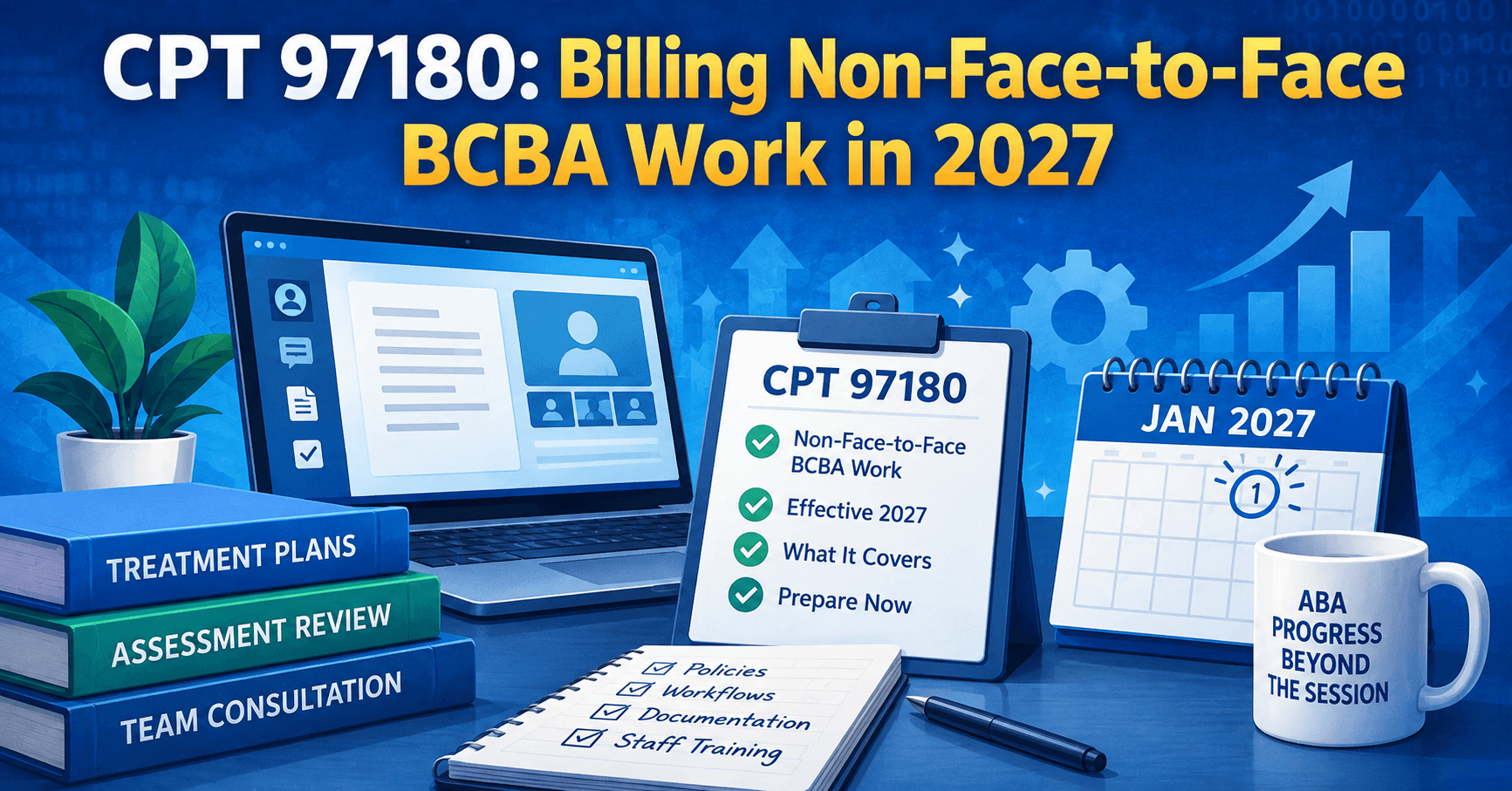
One more change is coming that touches documentation for every payer at once. The AMA published the CPT 2027 code set on September 9, 2026 (ABA Coding Coalition): six new adaptive behavior codes (97148, 97149, 97159, 97160, 97173, 97180), revisions to 97151 through 97158, and deletion of 0362T and 0373T, effective January 1, 2027 through the AMA CPT process. One of them, 97180 for non-face-to-face professional work, needs a documentation record with no session attached, which most note templates cannot produce today. Because a note has to support the specific code billed, every documentation template and staff training keyed to today's codes needs to be ready before the switch. Practices that prepare their documentation for the transition ahead of time will sidestep the code-to-note mismatch denials that reliably follow any code-set change.
Where VG Soft Co fits
Most of the payer-specific complexity above is a data problem before it is a clinical one: the right note elements, the right outcome measures, and the right visit record, captured at the point of service rather than reconstructed at month-end. That gets easier when documentation, scheduling, authorizations, and billing share one record instead of living in separate tools that have to be reconciled. VGPM is built that way, and its session notes prompt for the required fields during the session, which is where the cloning and omissions that fail audits tend to creep in. Software does not make the payer rules simpler; it removes the reconciliation gaps between systems that produce so many mismatches.
Tracking each payer's specific rules is the harder part, and it is work a practice can also hand off. The Revenue Cycle Management service manages that payer-specific layer directly: matching documentation to each payer's requirements, staying ahead of authorization and reassessment cadences, and working the CO-197 and CO-50 denials when they land. To be fair about the alternatives, this is not unique to one vendor. Established ABA platforms like CentralReach and Motivity handle multi-payer documentation at scale, and specialized billing companies do the payer-tracking work well; for a large or multi-specialty organization, their maturity may be the better fit. The right answer depends on your size and payer mix. What does not change is the underlying reality: in 2026 there is no single ABA documentation standard, there are several, and the practices that document to the payer rather than to a generic template are the ones that get paid. The wider operating system this fits into is mapped in the ABA practice operations guide.