TL;DR (For Practice Owners)
The ABA industry in 2026 is growing, consolidating, and tightening all at once. Demand is up (CDC prevalence hit 1 in 31 children), the workforce has expanded on paper but not in direct care (85,587 certified BCBAs, yet only about 30,000 in direct clinical service), Medicaid is paying closer attention (Indiana's overhaul went live April 1, North Carolina passed its own version April 28, and Kentucky's 4% cut lands August 1), and private equity keeps acquiring independent clinics (574 PE-owned centers across 42 states) even as large national providers exit low-reimbursement state Medicaid programs (ALP withdrew from Texas in March and New York in April).
- The market is bigger than most owners realize. Global ABA therapy services sit at roughly $8 billion in 2025 with steady single-digit growth. The software layer underneath is growing more than twice as fast.
- The workforce problem is retention, not production. Certification has more than doubled since 2021, but turnover runs 77% to 103% annually and replacement costs run $15,000 to $25,000 per therapist. The field certifies clinicians faster than it keeps them in direct service.
- Medicaid is the single biggest revenue risk. Rate cuts, hour caps, and OIG audits are reshaping the economics of Medicaid-heavy practices. Indiana was the bellwether. North Carolina was the first major copycat, and the pattern has since spread to Kentucky, South Carolina, and Nebraska, with at least 10 more states under House Energy and Commerce probes.
- Technology is a lever, not a luxury. Only about 9% of BCBAs use data-driven software for clinical decisions. Practices that invest in modern PM software, AI-assisted documentation, and automated billing are separating themselves on both operational cost and audit resilience.
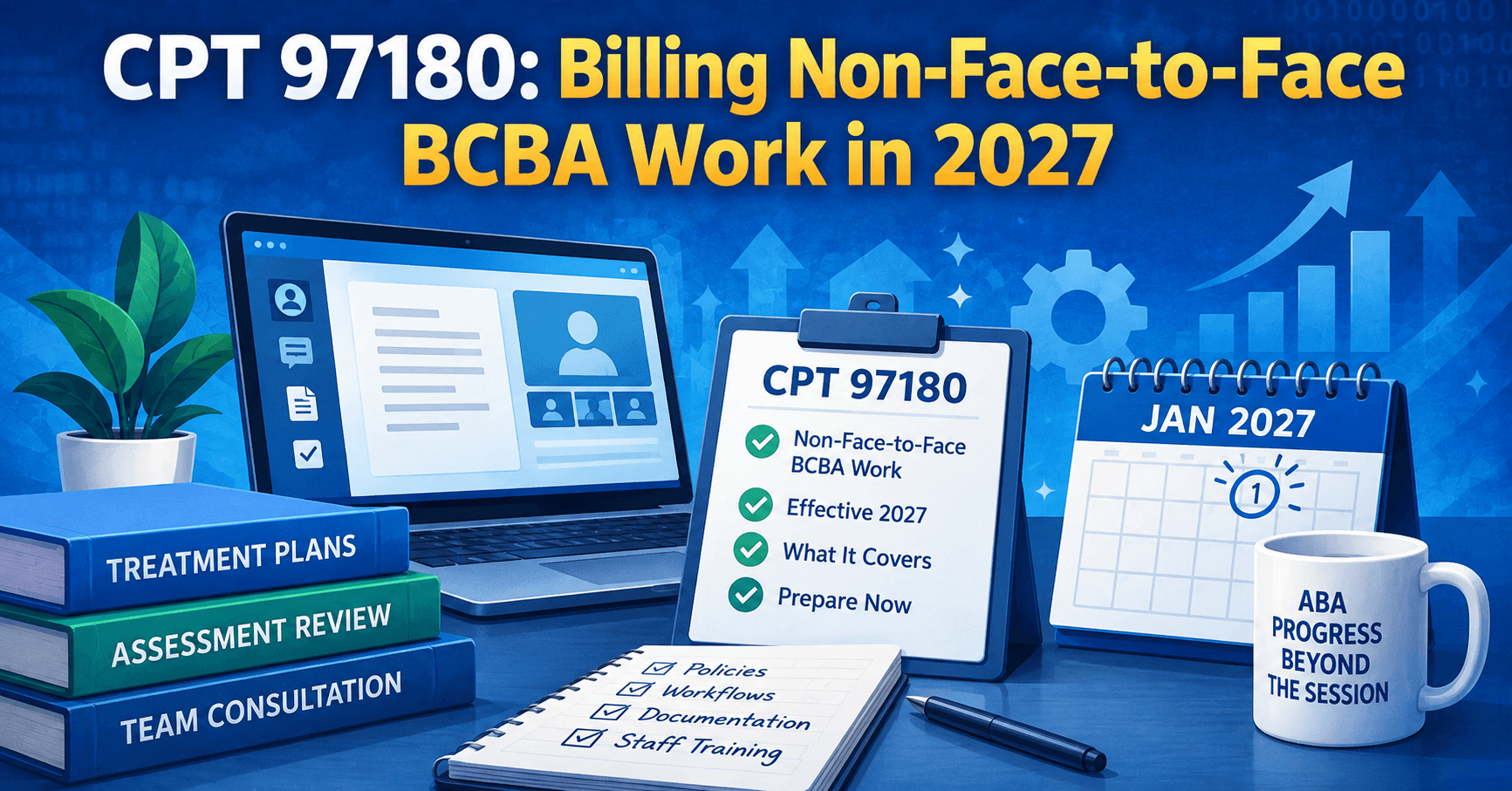
- The 2027 CPT codes are published. The AMA released the CPT 2027 code set on September 9, 2026: 97148, 97149, 97159, 97160, 97173, and 97180 join the set on January 1, 2027, including 97180, the first code for non-face-to-face BCBA work. The CMS comment period closed September 14; the final fee schedule rule is expected in November.
- Ownership models are multiplying. Independent BCBA ownership, franchise, MSO, and PE-backed groups now coexist. The decision of which model fits your practice is becoming a strategic one, not a default.
The Short Answer
The ABA therapy services market is worth roughly $7.97 billion in 2025 and is projected to reach $10.39 billion by 2031, a compound annual growth rate near 4.5%, while the practice management software layer beneath it grows at roughly 11%. The CDC now identifies autism in 1 in 31 eight-year-olds. There were 85,587 certified BCBAs as of July 1, 2026, but only about 30,000 work in direct clinical care against an estimated 100,000 needed, and annual turnover runs 77% to 103%. Medicaid is the primary revenue risk: multiple states cut ABA rates or capped hours in 2026, and HHS-OIG audits across four states have identified more than $285 million in improper or potentially improper payments. Six new adaptive behavior CPT codes take effect January 1, 2027, replacing the current T-codes.
This report is a living document. Scroll to the Monthly Update Log for recent changes.
Latest monthly update: See our June 2026 ABA News Roundup for the most recent month's developments.
How This Report Is Sourced
Every figure below traces to a named source, cited inline at the point of use. The recurring primary sources are CMS (fee schedule rules and prior authorization policy), the HHS Office of Inspector General (state Medicaid audits), the BACB (certificant counts and credentialing standards), the CDC's ADDM Network (prevalence), the ABA Coding Coalition (CPT code changes), and state Medicaid agencies and regional news coverage (rate and coverage policy). Market-size figures come from Mordor Intelligence and Verified Market Research.
Two limits are worth stating plainly rather than burying:
- Proposed is not final. Where this report covers rules still in comment or draft, including the CY2027 Medicare Physician Fee Schedule and North Carolina's Clinical Coverage Policy 8F, the outcome can still change. Those items are labeled as proposed everywhere they appear.
- Market-size figures are third-party projections, not audited results. Research firms scope the ABA market differently and their estimates diverge accordingly. Treat them as directional, not precise.
Last verified: July 29, 2026.
The ABA Therapy Market in 2026
The global ABA therapy services market sits at roughly $7.97 billion in 2025 and is projected to grow to about $10.39 billion by 2031, a compound annual growth rate near 4.5% (Mordor Intelligence). The U.S. accounts for the majority of that market. Children represent 86% of the market, and autism spectrum disorders account for about 70% of revenue.
What's interesting for practice owners is the mix underneath that headline number. The software and technology layer is growing at roughly 11% per year, more than twice the pace of the services market. Telehealth and remote supervision are the single fastest-growing segments. In other words, while overall demand is rising at a steady pace, the way ABA gets delivered is changing faster than the top-line market size suggests.
Insurance mandates remain the structural tailwind. All 50 states now require some form of private insurance coverage for autism-related services, and Medicaid coverage is functionally universal. That coverage floor is what creates demand visibility for new practice owners. The harder question isn't whether demand exists, it's whether reimbursement keeps pace with operating costs in your specific payer mix.
If you're evaluating the opportunity to start your own ABA practice, the market fundamentals favor you. Prevalence is rising, capacity is short, and parents are actively searching for providers. The execution challenges (credentialing, billing, staffing) are where most of the difficulty lives.
Who's Being Served and Who Isn't
The CDC's ADDM Network now identifies autism in 1 in 31 children age 8, up from 1 in 36 in the previous report and from 1 in 150 two decades ago (CDC ADDM Community Report). Boys are identified at 3.4 times the rate of girls. The racial disparity has flipped in the past decade: Black, Asian, and Hispanic children now have higher identified prevalence than White children, reversing historical patterns driven by diagnostic access gaps.
Access to ABA care has not kept up. Waitlists of six to twelve months are common in metro areas. In rural America, "ABA care deserts" are the norm, with some families driving two hours each way for services. Medicaid-dependent families bear the brunt of capacity shortages, because low-reimbursement states attract fewer providers.
The access gap is also a payer mix problem. Commercial insurance pays better than Medicaid in most states, which means profit-driven providers tend to cluster in commercially insured zip codes. Independent BCBAs who serve Medicaid populations in mid-sized cities and rural markets often find themselves with full caseloads and long waitlists, but thinner margins than their commercial-heavy competitors. A disciplined revenue cycle management operation is often the difference between sustainable margins and burnout in Medicaid-heavy practices.
The Workforce Challenge
The workforce gap is the constraint every practice owner feels daily, but the shape of it is widely misreported. As of July 1, 2026, there were 85,587 BCBAs, 5,246 BCaBAs, and 260,174 RBTs certified (BACB Certificant Data). Job postings for BCBA roles hit 132,307 in 2025, a 28% year-over-year increase. Those two numbers are close enough that the familiar "the field needs five times as many BCBAs" line, which circulated widely when certification sat near 48,000, no longer describes reality. Certification roughly doubled in four years. Postings exceed certificants by something closer to 1.5 to 1.
That matters because it relocates the problem. The binding constraint is not how many BCBAs the field produces, it is how many stay in direct clinical service. A widely read May analysis made exactly this point: only about 30,000 BCBAs work in direct clinical care against an estimated 100,000 needed, and 46% of U.S. counties still have no BCBA presence at all, down from 54% in 2018 (Behavioral Health Business). So the pipeline has more than doubled while the direct-care gap barely moved. Roughly two thirds of certified BCBAs are doing something other than direct billable clinical work: supervision, administration, school-based roles, consulting, or they have left the field. If you are hiring and cannot fill a role, the reason is not that the credential is scarce. It is that the job, as most practices have structured it, loses to the alternatives.
Turnover compounds the shortage. ABA organizations averaged annual turnover between 77% and 103% in 2024, with median RBT turnover around 65%. Replacing a single therapist costs $15,000 to $25,000. A 20-person clinical team with 50% turnover is looking at $150,000 to $250,000 per year just in replacement costs, before you count the client relationships lost, the scheduling disruption, or the supervision load on your BCBAs. In July 2026 the retention problem produced a first: 33 behavior technicians at a Rockville, Maryland provider staged what organizers describe as the first strike by ABA workers in U.S. history, after 440 days without a first contract. Trade coverage tied the standoff to frozen Medicaid rates as much as to the employer, which is exactly the squeeze the turnover numbers have been signaling (July 2026 roundup).
Compensation is rising, but unevenly. BCBA salaries sit at $85,000 to $100,000 nationally, with total compensation crossing $120,000 in high-demand markets. RBTs earn $20 to $26 per hour on average. The top-paying regions are California, Alaska, and Texas. The pipeline keeps expanding: total BACB certificants across all credentials now exceed 351,000, up from about 38,000 in 2015. Supply is not the failure point. Deployment and retention are.
What separates the practices that retain staff from the ones that don't isn't usually compensation alone. It's structured onboarding, clear career paths for RBTs, supervision ratios that don't grind your BCBAs into burnout, and operational systems that eliminate the documentation chaos that eats everyone's time. Practices that invest in all of this report retention rates as high as 97%.
For larger practices looking to scale without building operational infrastructure from scratch, the ABA Practice Accelerator handles credentialing, HR, and operations so clinical leadership can focus on retention and culture instead of administration.
Reimbursement, Billing, and the Revenue Squeeze
Medicaid is where the reimbursement story gets sharp. State Medicaid spending on ABA roughly tripled from about $660 million in 2019 to $2.2 billion in 2023, and the growth curves at the state level are even steeper (North Carolina alone went from $1.9 million in 2020 to $505 million in 2025). Several states are now actively pulling back.
Indiana is now operating under the most restrictive ABA Medicaid policy in the country. The Bulletin BT202627 changes went live April 1, 2026: a 6% rate cut, a 4,000-hour lifetime cap, a 30-hour weekly maximum, and an age 21 cutoff (with full adult phase-out by October 1, 2026). A second 4% rate cut is already scheduled for April 1, 2027. Indiana also expanded provider eligibility, allowing BCBAs, BCaBAs, and health service providers in psychology to bill direct service alongside RBTs, where previously only RBTs could (Hall Render summary). In May, Indiana went further, announcing a six-month moratorium on new ABA group enrollments and changes of ownership after a federal audit estimated the state improperly paid roughly $56 million for ABA services; CMS approved the request and the freeze took effect June 6, 2026 (Hall Render). Enforcement in the state is no longer theoretical: Indianapolis-based Stepping Stones Behavioral Solutions, which had collected $45.5 million in Medicaid payments since 2019, closed with one day's notice in June after a payment freeze and a payer network termination, without any fraud finding ever being announced.
North Carolina passed HB 696 on April 28, 2026, making it the first major state to follow Indiana's playbook. The bill bans out-of-state providers from enrolling in NC Medicaid (unless they operate within 40 miles of the border), prohibits telehealth for behavioral assessments and treatment sessions, caps supervisory telehealth at 10%, requires in-person LQASP assessments, and imposes a 16-hour weekly cap with monthly reverification for higher-hour plans (NC Health News). Governor Stein signed HB 696 into law on April 30, and on May 14 the state released draft revisions to Clinical Coverage Policy 8F, the operating rules that turn the statute into day-to-day requirements, with a public comment window through June 14 (Carolina Journal).
Other states are tightening through different mechanisms. New York issued two 12.5% Medicaid ABA rate cuts (October 2025 and April 2026), combining to a ~23% effective reduction that drove Autism Learning Partners to close all NY Medicaid panels effective April 17. Georgia's largest Medicaid MCO, CareSource, cut reimbursement to 80% of the state fee schedule effective May 11, 2026, after a 45-day "accept or exit" objection window that has now closed. On July 21 CareSource partially reversed course, rescinding the cut for providers in counties the state designated as shortage areas (40 of Georgia's 159 counties already have no CareSource therapy provider at all); everyone else still absorbs it. Nebraska cut RBT rates by up to 48%. Massachusetts is tightening by standing still: MassHealth proposed re-adopting its ABA fee schedule unchanged from October 2024 (97153 at $16.37 per unit) through at least 2027, holding rates flat against wage inflation even as a January 2026 eligibility expansion added members under 21 with Down syndrome to the benefit.
A distinct fourth mechanism deserves its own mention, because it reduces revenue without touching a published rate: restricting concurrent billing. Vermont discontinued concurrent 97153 and 97155 billing effective January 1, 2026, and Texas, Virginia, and Michigan's largest commercial payer have each imposed their own version of concurrency or session limits. A practice can hold its rates and still lose double-digit revenue percentages if two clinicians can no longer bill overlapping time that was previously authorized. The state-by-state detail, including Vermont's own finding that concurrency had inflated authorized tier hours by roughly 12%, is in our ABA billing codes reference.
The tightening continued through the summer, though July also produced the first outright reversal. Kentucky had scheduled a 4% fee-for-service Medicaid cut across 46 provider types for August 1, 2026 (Louisville Public Media); on July 22 the governor reversed it, citing an unexpected $255 million budget surplus, before it ever took effect. A 2.5% cut on the managed-care side is still scheduled for 2028, so the reprieve is real but not permanent. South Carolina replaced its Autism Spectrum Disorder Services Provider Manual for dates of service on or after July 1, 2026, with a revised fee schedule effective the same day (SCDHHS). Nebraska put new service definitions into effect the same day, cutting its prior-authorization-free ceiling from 30 to 20 hours per week, and Virginia's 20-hour weekly default cap on Medicaid ABA also took effect July 1. The count of states resetting their ABA Medicaid rules keeps climbing. It is the operating environment.
Sitting behind the state-level policy changes are the federal audits. The HHS Office of Inspector General has completed four state-level audits of Medicaid ABA payments so far (Indiana, Wisconsin, Maine, Colorado). Cumulative findings now total more than $285 million in improper or potentially improper payments across those four states, with all 100 sampled enrollee-months including improper claims in the most recent Maine and Colorado reports (OIG Maine report, OIG Colorado report). The HHS-OIG has committed to nine total state audits, and the House Energy and Commerce Committee has opened probes into at least 10 additional state Medicaid ABA programs. These findings are the enforcement rationale every state points to when tightening controls.
Commercial payers are tightening too, just more quietly. More payers are deploying AI-driven utilization management that compares your session notes against billed CPT codes. Documentation inconsistency, not missing documentation, is the pattern showing up in denials. Friction is a second lever: HCSC, the Blue Cross Blue Shield licensee for Illinois, Montana, New Mexico, Oklahoma, and Texas, moved ABA prior authorizations to live phone calls plus fax in 2026, a process providers described as badly bottlenecked by midsummer. The practical takeaway: your notes, your billing codes, and your treatment plans need to tell the same story, and your authorization workflow needs to survive a payer that goes analog.
The 2027 CPT code overhaul adds a structural shift on top of all this. The AMA approved the ABA Coding Coalition's code change application in September 2025. Six new codes are added, 97151 through 97158 are revised, and the current T-codes (0362T, 0373T) are deleted effective January 1, 2027 (ABA Coding Coalition).
For most of 2026 that was all anyone outside the AMA process could say, because the specifics stay confidential until publication. Two things changed. On July 14, 2026, CMS released its proposed CY2027 Medicare Physician Fee Schedule (CMS-1848-P), and because the agency has to propose valuation for codes it expects to price, the rule revealed the structure of all six codes under AMA placeholders (ABA Coding Coalition). Then on September 9, 2026, the AMA released the CPT 2027 code set and the codes got their numbers (ABA Coding Coalition confirmation, September 10):
| Code | CMS placeholder | What it covers |
|---|---|---|
| 97148 | 97X1X | Behavior identification supporting assessment of harmful behavior, requiring two technicians in a customized environment |
| +97149 | 97X2X | Add-on: each additional technician for a harmful-behavior assessment |
| 97159 | 97X4X | Adaptive behavior treatment of harmful behavior, requiring two technicians in a customized setting |
| +97160 | 97X5X | Add-on: each additional technician for harmful-behavior treatment |
| 97173 | 97X6X | Adaptive behavior treatment with analysis, delivered face to face by a BCBA or other qualified health professional to one patient (split out of 97155) |
| 97180 | 97X3X | Non-face-to-face professional work: data review, clinical decision-making on protocol modifications, discharge planning, and protocol training |
Read the honest limits before you plan around this. The numbers are official, but Medicare valuation is not: all six carried a "C" in the RUC and CMS work RVU columns of the proposed rule, and CMS proposed extending carrier pricing for adaptive behavior services through 2027, so Medicare sets no national rate either way and you will still be negotiating with payers. The comment period closed September 14, 2026, and the final rule is expected in November. Full descriptors and guidelines publish in the 2027 CPT Professional Edition late this year.
One of the six is more consequential than the rest: 97180. BCBA indirect clinical work has no real billing home today outside 97151. Protocol review, data analysis between sessions, decisions about modifying a treatment plan, and training technicians on a revised protocol are all real clinical labor that most practices currently absorb as unbillable overhead. On January 1, 2027, that work becomes billable for the first time under 97180. The practices positioned to capture it on day one are the ones already tracking indirect BCBA time at the task level, because they will have the documentation trail a payer will ask for. The practices that record indirect time as a weekly lump, or not at all, will spend most of 2027 building the tracking habit instead of billing against it. That is a documentation-system question you can act on now, well before the codes activate.
There is also an unresolved risk worth watching rather than assuming away. CMS proposed keeping the current 97151 through 97158 codes on its permanent telehealth list, but the rule did not address whether any of the six new codes will be telehealth-eligible. The ABA Coding Coalition has said it intends to request their addition. For any practice whose model leans on remote assessment or remote protocol modification, that silence is the single most important open question, and the November final rule is where it gets answered; the comment period closed September 14 with the Coalition on record requesting permanent telehealth status for all six.
Practices are responding in one of two ways. Some are doubling down on in-house billing, investing in stronger documentation workflows and compliance oversight. Others are shifting to outsourced ABA billing partners who specialize in ABA-specific denial patterns and payer rules. Neither approach is universally right. The decision comes down to your current denial rate, your collection percentage, and whether your in-house team has the bandwidth to stay ahead of policy changes.
Technology Adoption in ABA Practices
The ABA software market is growing from $456 million in 2024 to a projected $960 million by 2032, at an 11.22% compound annual growth rate (Verified Market Research, 2025). That's more than twice the pace of the underlying services market, which tells you where provider investment is flowing.
Three technology trends stand out in 2026:
AI-assisted session notes have moved from pilot to standard in larger practices. Small practices report reducing session note review time from 10 hours per week to about 3 hours per week after adopting AI-assisted drafting tools. That's 30 hours per month your BCBAs get back for clinical work. AI-powered session notes are particularly valuable because they don't just speed up documentation, they also improve consistency, which matters for audit defensibility.
Integrated practice management software is replacing stacks of disconnected tools. The pattern of using one tool for scheduling, another for session notes, another for billing, and another for data collection is still common in smaller practices, but it's increasingly a liability. Fragmented data creates the exact documentation inconsistencies that drive denials. Practices are consolidating onto integrated platforms like VGPM that handle scheduling, documentation, data collection, authorization tracking, and billing in one system.
Data-driven clinical decision making is still early. Industry analysis suggests only about 9% of BCBAs currently use data-based software to inform hour recommendations, treatment intensity, or progress measurement. This is a meaningful gap. Payers are moving toward outcomes-based models, and the practices that can show measurable progress data will have leverage in authorization negotiations.
Telehealth supervision continues to expand. Research suggests 77% of clients show the same or improved outcomes in telehealth compared to in-person ABA, and telehealth delivery can be roughly six times less expensive. State Medicaid programs are increasingly accepting telehealth supervision models as permanent rather than pandemic-era exceptions.
The BACB has not issued AI-specific guidelines as of early 2026. Practitioners remain bound by the existing Ethics Code, which covers data privacy, informed consent, and the use of evidence-based practice. CASP published AI Practice Parameters for autism service providers that cover similar ground.
Regulatory and Compliance Landscape
State licensure for behavior analysts is now the norm, with most states requiring BCBA licensure in addition to BACB certification. Scope-of-practice laws, supervision requirements, and documentation standards vary significantly by state, which creates real operational friction for multi-state practices. North Carolina's HB 696 (passed April 28, 2026) added a new dimension to this fragmentation by banning out-of-state Medicaid providers entirely (except those within roughly 40 miles of the patient), restricting telehealth for behavioral assessments and treatment sessions, and limiting remote supervision. The final operating rules are now set, and they took effect August 1, 2026: reauthorization every three months for clients at 16 or more weekly hours (eased from the draft's monthly requirement), remote supervision of technicians capped at 20% of service time (tighter than the 50% the statute allowed), and an out-of-state restriction that sidelines most of the 52% of NC-licensed BCBAs who live elsewhere. NC Medicaid's July 21 provider bulletin drew the compliance lines explicitly: childcare, transportation, academic instruction, and staff training are non-billable, and provisional diagnoses under age 3 must be finalized within six months (July 2026 roundup). Practices operating regionally across state lines need to recheck their enrollment status in any NC-adjacent operation.
Indiana's April 1, 2026 overhaul also reshaped provider eligibility, allowing bachelor's-level BCaBAs, doctoral-level BCBAs, master's-level BCBAs, and health service providers in psychology to bill ABA services directly, where previously only RBTs could deliver billable hours. Other states are expected to follow suit as workforce pressure forces more flexibility around who can deliver authorized service hours. Separately, Indiana's freeze on new provider enrollment and ownership changes received CMS approval and took effect June 6, 2026, running at least six months with extensions possible, a market-entry control that goes beyond rate and eligibility rules. Enrolled agencies faced their own deadline: proof of progress toward CASP-recognized accreditation was due August 1, with deactivation the stated consequence.
The federal oversight structure itself shifted in June 2026. The Department of Education transferred day-to-day administration of special education (including the Office of Special Education Programs) to HHS on June 16, with civil-rights enforcement moving to the Department of Justice. Two days later, the DOJ's Office of Legal Counsel issued a memo arguing that the ADA does not require states to provide services in the most integrated setting appropriate to a person's needs, a narrowing of the long-standing reading of Olmstead v. L.C. (The Arc). Neither action changes statute, but both change who enforces disability-services requirements and how aggressively. July's follow-through made the direction concrete: DOJ formally noticed that it no longer treats its longstanding Olmstead guidance as enforceable, and the counter-move surfaced in Congress rather than the courts, where disability advocates are backing the bipartisan Latonya Reeves Freedom Act to write community-integration rights into statute. Practices with school-based contracts or community-integration funding streams should track both transitions closely.
The BACB rolled out new RBT standards effective January 1, 2026, including a 40-hour training requirement aligned with the 3rd Edition RBT Test Content Outline and a shift to two-year renewal cycles. The 12-hour professional development requirement now replaces the Renewal Competency Assessment for most renewals. Reading an article with a knowledge check will no longer count as an ACE event effective July 1, 2026, which narrows what counts as continuing education. BCBA Pathways 3 and 4 discontinuation was pushed to January 1, 2027. Practices running RBT training programs need to verify their curricula meet the new standards. The transition infrastructure itself stumbled in July: the BACB's new certificant portal, launched June 29, left the public registry dark for weeks, stalling RBT renewals and credential verification. Practices that renewed or verified anything during the outage should keep dated screenshots and confirmations on file, because a credential gap you can document beats one you have to explain from memory.
CMS updated prior authorization rules took effect January 1, 2026. Standard prior authorization decisions must now be made within 7 calendar days (down from 14), payers must provide specific reasons for denials, and payers must publicly report their prior authorization metrics. Behavioral health services are expected to be integrated into broader prior auth reform later in 2026.
HIPAA and state data privacy regulations are getting more attention, particularly as AI tools handle more clinical documentation. Practices adopting AI-assisted documentation should review their business associate agreements with software vendors and confirm how PHI is stored, processed, and retained.
Credentialing timelines remain one of the most frustrating parts of opening or expanding a practice. Getting credentialed with major Medicaid programs and commercial payers can take six to nine months. For new BCBAs launching their first practice, the ABA Practice Incubator can accelerate credentialing and payer enrollment so you're billing faster.
The Practice Ownership Landscape
ABA practice ownership is more varied than it was five years ago. Four models now coexist, and the decision of which one fits your practice has become a strategic one.
Independent BCBA-owned practices remain the backbone of the industry. Clinical autonomy, full financial upside, and flexibility to serve your specific community are the core advantages. The challenges are operational: billing, credentialing, HR, compliance, and the fact that you're the one responsible for everything. For many BCBAs, independence is worth the operational weight. For others, it's a grinding burden that eventually pushes them toward one of the alternatives below.
Franchise models offer brand and operational playbooks in exchange for upfront fees ($12,000 to $50,000+) and ongoing royalties (typically 5% to 8% of revenue). You operate under the franchisor's brand, clinical protocols, and territory restrictions. Franchises work for owners who want a turnkey operational system and are comfortable trading autonomy for structure. They don't work for BCBAs who want clinical flexibility or regional brand building. We cover the trade-offs in more depth in our ABA franchise alternative guide.
Management Services Organizations (MSOs) sit between independence and franchise. You keep your practice name, your clinical autonomy, and full ownership, but you outsource the non-clinical operations (billing, credentialing, HR, compliance, administration) to the MSO. Pricing is typically 10% to 20% of collected revenue, with no upfront fees and no brand restrictions. The MSO model is growing quickly because it preserves what BCBAs care most about (clinical control, ownership) while solving what burns them out (operations). We walk through the structure in what is an ABA MSO.
Private equity-backed groups represent the fourth path, typically reached by selling majority ownership to a PE firm that consolidates multiple practices into a larger platform. Brown University's JAMA Pediatrics study (January 2026) mapped the current scale: 574 PE-owned ABA centers across 42 states, built from 147 acquisitions between 2015 and 2024 (JAMA Pediatrics / Brown University). California leads with 97 PE-owned centers. About 80% of those acquisitions happened between 2018 and 2022. PE provides liquidity and scale, but typically in exchange for majority control.
The counter-narrative worth watching is the wave of exits in 2026. Autism Learning Partners, one of the largest national ABA providers, withdrew from Texas Medicaid in March 2026 and closed all New York Medicaid panels in April 2026 following compounding rate cuts. Capital is repositioning toward higher-reimbursement states (ALP simultaneously expanded in California) and exiting lower-reimbursement ones. For independent practices, that's a leading indicator. If a PE-backed national operator can't make a given state's Medicaid math work, the structural pressures are even sharper for a single-site practice with less administrative leverage.
The trade-off matrix is worth thinking through before you commit to any of these models. Most BCBAs optimize around autonomy and clinical control, which rules out franchise and PE in most cases. The meaningful choice is usually between running fully independent and partnering with an MSO.
What's Ahead: ABA Therapy Outlook
Looking forward 12 months, a few trends look durable enough to plan around.
Medicaid policy tightening will continue, but July proved it can be pushed back on. Indiana's framework is no longer hypothetical, and it's no longer alone. North Carolina's final rules took effect August 1, 2026, South Carolina, Nebraska, and Virginia all reset their rules effective July 1, and the House Energy and Commerce Committee has opened probes into at least 10 additional state Medicaid ABA programs. The other direction is now proven too: Kentucky reversed its scheduled 4% cut outright and Georgia's CareSource rescinded its 20% cut in shortage counties after organized provider and family pressure, which makes state-association advocacy a line item with measurable ROI. Watch Ohio, Michigan, and other high-growth-spend states for the next round of bills. Practices that haven't modeled their economics under a 30-hour weekly cap or a 10% rate cut should do so before the changes arrive. And watch the rulemaking phase, not just new bills: North Carolina's now-live Policy 8F and Indiana's enrollment moratorium show the tightening extending from rates into day-to-day operations and market entry. A federal layer is now in play too: special-education administration moved to HHS in June, DOJ narrowed its Olmstead enforcement posture (with a legislative counter-move, the Latonya Reeves Freedom Act, now circulating), and a new DOJ National Fraud Enforcement Division plus a fast-track whistleblower program are turning audit findings into prosecutions. The oversight map above the states is being redrawn mid-cycle.
Workforce pressure will keep separating practices. The ones investing in retention infrastructure (structured onboarding, career paths for RBTs, sustainable supervision ratios) will compound their advantages. The ones running hot-pot turnover will hemorrhage margin.
Technology adoption will accelerate, then consolidate. The practices that adopt integrated PM software and AI-assisted documentation in 2026 will be ahead. The practices that wait until 2027 or 2028 will be playing catch-up against competitors who have already refined their workflows.
Ownership models will keep proliferating. Expect to see more MSO models launch, more PE-backed platforms buy regional chains, and more BCBAs choosing independence with operational support rather than full DIY or full franchise.
The 2027 CPT code overhaul will separate the prepared from the unprepared, and the calendar is now fully specific. The code numbers published September 9, 2026. The comment period on the CY2027 fee schedule closed September 14. The final rule lands in November, and the codes activate January 1, 2027. That leaves one quarter between knowing the codes and having to bill against them. Practices that spend Q4 2026 mapping workflows to 97148 through 97180, updating their billing configuration, and retraining staff will transition cleanly. Practices that wait for the Professional Edition will be doing all of it in December. The single most useful preparation item is the one described above: start tracking indirect BCBA time at the task level now, so you can bill 97180 on day one rather than reconstructing months of undocumented work.
The practices navigating 2026 well aren't doing anything exotic. They're running clean operations, documenting thoroughly, retaining their staff, and staying two steps ahead of policy changes. That's the playbook. For the discipline-by-discipline version of it, the ABA Practice Operations Guide breaks the nine operational disciplines down with benchmarks and scaling break-points.
Monthly Update Log
A running log of updates to this report, with links to the monthly roundup that informed each change.
- September 18, 2026 (substantive update, not a date bump): The AMA published the CPT 2027 code set on September 9, so the six adaptive behavior codes now have numbers (97148, 97149, 97159, 97160, 97173, 97180). The 2027 section, its FAQ, the TL;DR bullet, and the closing outlook were rewritten from "structure under CMS placeholders" to the published codes; the placeholder mapping is kept in the table. The CMS-1848-P comment period closed September 14. No market, workforce, or payer figures changed.
- August 2026: Added July 2026 ABA News Roundup coverage. July was the month the squeeze went fully operational: the first strike by ABA workers in U.S. history (Rockville, MD, July 20), North Carolina's final Policy 8F effective August 1 (quarterly reauthorization, 20% remote-supervision cap, 40-mile out-of-state rule), Kentucky's 4% cut reversed outright and Georgia's CareSource cut rescinded in shortage counties, Nebraska, South Carolina, and Virginia tightening effective July 1, HCSC moving ABA prior auth to phone and fax, the BACB portal outage stalling renewals, and DOJ's new fraud-enforcement machinery producing its first template case. Refreshed the Workforce, Reimbursement, Regulatory, and Outlook zones.
- July 29, 2026 (substantive refresh, not a date bump): Three changes worth naming. (1) Corrected the workforce numbers and the conclusion drawn from them. This report previously cited about 48,352 BCBAs and repeated the widely circulated claim that the field needs five times as many BCBA-level clinicians. BACB certificant data as of July 1, 2026 puts the actual figure at 85,587 BCBAs, 5,246 BCaBAs, and 260,174 RBTs, so certification has roughly doubled since 2021 and the 5-to-1 framing is no longer accurate. Rewrote the Workforce section around what the data actually shows: supply is not the failure point, direct-care retention and deployment are. (2) Added the CY2027 Medicare Physician Fee Schedule reveal. CMS released CMS-1848-P on July 14, 2026, which publicly disclosed the structure of all six new 2027 adaptive behavior codes under AMA placeholders. Added the full placeholder table, the honest limits (valuation pending, carrier pricing extended through 2027), the September 14 comment deadline, an analysis of why 97X3X is the consequential one for practice economics, and the unresolved telehealth-eligibility question CMS left unaddressed. (3) Added the summer state wave: Kentucky's 4% fee-for-service cut effective August 1, South Carolina's replaced ASD provider manual and Nebraska's new service definitions effective July 1, plus concurrent-billing restriction documented as a distinct fourth tightening mechanism. Also added a sourcing and methodology disclosure with a last-verified date, a quotable summary block, and two FAQs (2027 code status, state-by-state Medicaid changes).
- July 2026: Added June 2026 ABA News Roundup coverage. June was the month enforcement got teeth: Indiana's provider-enrollment moratorium received CMS approval and took effect June 6, Stepping Stones Behavioral Solutions closed overnight after a payment freeze and payer network termination (no fraud finding ever announced), North Carolina's 8F comment window closed June 14 with the final policy expected around August, MassHealth proposed holding ABA rates at October 2024 levels, and Washington moved special-education administration to HHS while DOJ narrowed its Olmstead enforcement reading. Refreshed the Reimbursement, Regulatory, and Outlook zones.
- June 2026: Added May 2026 ABA News Roundup coverage. May was the month implementation caught up with legislation: North Carolina signed HB 696 (April 30) and released draft Clinical Coverage Policy 8F (May 14, comments through June 14), Indiana moved to freeze new provider enrollment and ownership changes for six months starting June 6, CareSource Georgia's 20% cut went live May 11, and a flight-to-quality M&A wave (FullBloom selling Little Leaves to LEARN) showed buyers paying premiums for clean, well-documented practices. Refreshed the Workforce, Reimbursement, and Regulatory zones.
- May 2026: Added April 2026 ABA News Roundup coverage. April was the most consequential regulatory month for ABA in years: Indiana's Medicaid overhaul went live April 1, North Carolina passed HB 696 with its own copycat playbook on April 28, Autism Learning Partners exited New York Medicaid, and CareSource Georgia issued a 20% rate cut. Indiana is no longer the only state with a comprehensive ABA overhaul.
- April 2026: Initial publication. Synthesizes twelve months of industry data across market size, workforce, reimbursement, technology, regulatory, and ownership dimensions. See March 2026 ABA News Roundup for the most recent monthly developments.
Related: VGPM ABA Software | ABA Revenue Cycle Management | ABA Practice Accelerator | ABA Practice Incubator | ABA Practice Operations Guide