This guide is for the practice owner or clinical director who can deliver excellent ABA but keeps getting pulled under by everything around it: the denials, the credentialing delays, the turnover, the audit anxiety. Operations is the part of running a practice that nobody trains BCBAs to do, and it is also the part that decides whether a clinically strong practice survives financially. What follows is a working framework: nine operational disciplines, what good looks like in each, and where the break-points sit as you grow. Reviewed by the VG Soft Co Clinical and Operations team.
TL;DR
- Operations breaks into nine disciplines. Documentation, data collection, authorization and credentialing, compliance, staffing, performance management, revenue cycle, technology, and the review cadence that keeps them honest. A practice fails operationally long before it fails clinically.
- The constraint changes as you scale. At 10 staff the owner is the operations function. By 25 it becomes a role, by 50 a team, by 100-plus a department. Each transition triggers a temporary margin dip you should plan for.
- Operations cost grows as a percentage of revenue, not shrinks. It runs roughly 5.4% of collected revenue at 10 staff and climbs toward 7.6% at 100 staff, because compliance complexity compounds faster than billing volume scales.
- Most denials trace to documentation and authorization, not bad luck. Authorization gaps alone drive 30 to 50% of denial volume. The fix is a same-day cadence, not a month-end cleanup.
- Retention is an operations problem, not a pay problem. Median RBT turnover runs 65%, replacement runs $15,000 to $25,000 per therapist, and the practices that beat it win on structure, not salary.
What ABA Practice Operations Means in 2026
Operations is everything that has to run correctly for clinical care to get delivered and reimbursed, separate from the therapy itself. It is the invisible infrastructure: the claim that gets paid the first time, the authorization that does not lapse mid-treatment, the RBT who stays past the first year, the audit that comes back clean. None of it shows up in a session, and all of it determines whether the practice can keep holding sessions.
Most owners underinvest in operations because the cost of neglect is delayed. You can run loose documentation for a year before the denials catch up. You can skip the compliance calendar until a license lapses. You can tolerate 80% turnover until the recruiting cost quietly eats your margin. The industry calls this operations debt, and like any debt it accrues interest. The practices that struggle in 2026 are rarely the ones with weak clinical skills. They are the ones that let operations debt compound until it became a cash-flow crisis.
The backdrop makes this sharper. Demand keeps rising, with the CDC now identifying autism in 1 in 31 children. Reimbursement is tightening through Medicaid rate cuts and hour caps. Federal audits are recovering improper payments at a scale the field has not seen before. In that environment, operational discipline is not back-office hygiene. It is the difference between a practice that compounds and one that leaks. For the wider market context behind these pressures, see the State of ABA Therapy industry report.
Discipline 1: Clinical Documentation That Survives Audit
Documentation is where clinical work becomes a billable, defensible record, and it is the single most common point of operational failure. The problem is rarely missing documentation. It is inconsistent documentation: notes that do not match the billed code, session times that do not reconcile with the authorization, or medical-necessity language that varies clinician to clinician.
Payers have gotten more sophisticated about catching this. More commercial plans now run automated utilization review that compares your session notes against the billed CPT codes, and the denials that result (often remittance codes like CO-50 for medical necessity or CO-252 for missing information) are preventable with a documentation standard. Every note should tie the session to the authorization, link the RBT's delivered service to the supervising BCBA, capture start and stop times and location, and use medical-necessity language consistent with the treatment plan. The BACB Ethics Code sets the professional floor for documentation integrity, and audit defensibility builds on top of it. Those requirements are not uniform, and what Medicaid, commercial plans, and TRICARE each expect diverges in ways that decide whether a claim gets paid, broken down in ABA documentation requirements by payer.
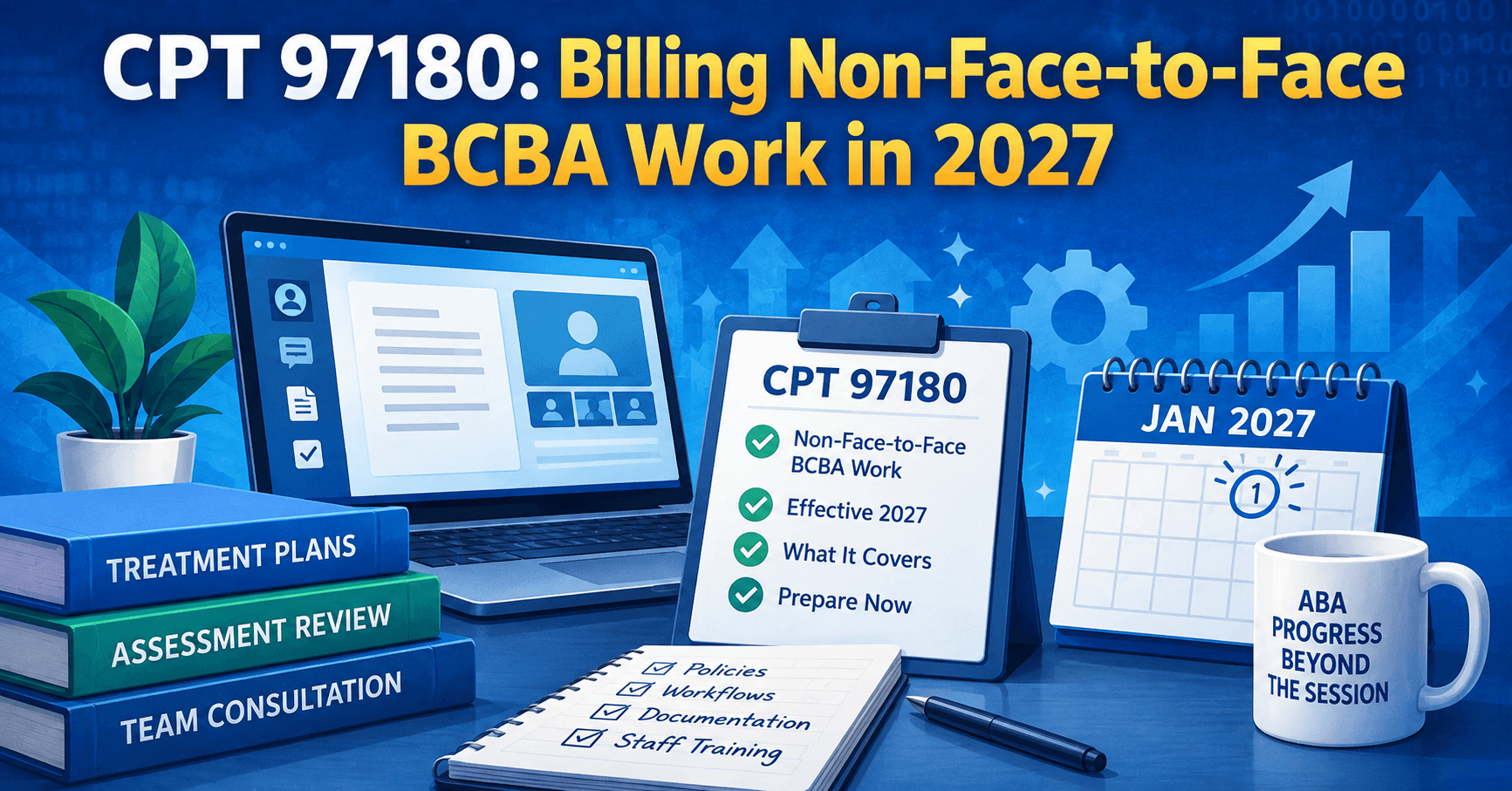
The 2027 CPT code overhaul raises the stakes. The AMA published the CPT 2027 code set on September 9, 2026: six new adaptive behavior codes (97148, 97149, 97159, 97160, 97173, 97180), revised 97151 through 97158, and deleted T-codes, effective January 1, 2027 (ABA Coding Coalition, AMA CPT). Every documentation template and staff training needs to be ready before the switch. The operational answer is a documented note standard plus a same-day review cadence, not a month-end scramble. We go deep on the specific failure modes in 8 ABA session notes mistakes that trigger denials, and the coding mechanics live in the ABA billing codes reference. Software that suggests note fields during the session, like VGPM's session notes feature, reduces the inconsistency that drives denials, but the discipline matters more than the tool.
Discipline 2: Data Collection That Drives Clinical Decisions
Data collection is the clinical heartbeat of an ABA practice, and operationally it is where clinical quality and audit defensibility meet. The method you choose (frequency, duration, interval recording, task analysis, ABC data) has to match the behavior being measured, or the data tells you nothing useful and defends nothing under review.
The operational gap here is not knowing the methods. It is collecting data consistently across a team of RBTs with varying experience, then actually using it to inform treatment decisions rather than letting it sit in a system unread. Industry analysis suggests only about 9% of BCBAs currently use data-driven software to inform hour recommendations and progress measurement, which is a remarkable gap given that payers are moving toward outcomes-based authorization. The practices that can show clean, consistent progress data have a stronger hand in authorization negotiations than data-poor practices do.
Getting this right means standardizing how each method gets collected, training RBTs to a shared standard, and reviewing the data on a cadence that catches collection drift early. We break down each method and when to use it in 12 ABA data collection methods explained. Real-time digital collection, such as VGPM's data collection tools, reduces the transcription errors and lag that undermine paper-based systems, and it makes the data immediately usable for the clinical decisions and authorization defense that depend on it. For a vendor-neutral view of the options, the best ABA data collection software comparison covers the landscape.
Discipline 3: Authorization, Eligibility, and Credentialing
This is the gate between delivering service and getting paid for it, and it is where a lot of revenue quietly disappears. Three connected functions live here: verifying a client's eligibility before service, securing and tracking authorizations so they never lapse mid-treatment, and credentialing your clinicians with payers so their delivered hours are billable in the first place.
Credentialing is the slowest and most underestimated of the three. Getting credentialed with major Medicaid programs and commercial payers takes 6 to 9 months, and starting services before enrollment completes is one of the most expensive mistakes a new practice makes: you deliver care you cannot bill. Eligibility and authorization are faster but require relentless cadence. An expired authorization is an automatic denial (CO-197), and re-verifying eligibility monthly catches the coverage changes that produce CO-27 and PR-204 denials. The administrative cost of these transactions is well documented in the CAQH Index, which tracks how much manual eligibility and authorization work costs the healthcare system every year.
CMS tightened the rules in your favor here: as of January 1, 2026, standard prior-authorization decisions must be made within 7 calendar days, down from 14. Operationally, the answer is tracking software that flags authorization expirations weeks ahead and a credentialing process that starts the moment you decide to add a clinician or payer. VGPM's authorization management and credential tracking features handle the alerting, and for new practices the ABA Practice Incubator accelerates initial payer enrollment so you are billing faster. If you are standing up a practice from scratch, the how to start an ABA practice guide sequences credentialing into the broader launch.
Discipline 4: Compliance Architecture, Federal, State, and Payer Layers
Compliance is no longer a once-a-year worry. It now operates on three layers that each move independently, and a gap in any one can trigger recoupment, denial, or worse. The federal layer is HIPAA plus the escalating Medicaid enforcement environment. The state layer is licensure, scope-of-practice rules, and increasingly aggressive state Medicaid policy. The payer layer is each plan's specific documentation and authorization requirements.
The federal pressure is real and quantified. The HHS Office of Inspector General has completed multiple state-level audits of Medicaid ABA payments and identified more than $285 million in improper or potentially improper payments, with the most recent reports finding problems in every sampled enrollee-month (OIG reports). The House Energy and Commerce Committee has opened probes into at least 10 additional state programs. The apparatus grew again in 2026: DOJ stood up a National Fraud Enforcement Division and a fast-track whistleblower-review program this spring, and a 15-defendant, $90 million Minnesota Medicaid prosecution is the template case. This is the enforcement rationale states cite when they tighten controls, and it means documentation that would have passed three years ago may not pass now.
The state layer is fragmenting fast. Indiana's overhaul went live April 1, 2026, its CMS-approved freeze on new ABA provider enrollments took effect June 6, and enrolled Indiana agencies had until August 1 to document progress toward CASP-recognized accreditation or face deactivation. North Carolina's final operating rules took effect August 1, 2026: reauthorization every three months for clients at 16 or more weekly hours, remote supervision capped at 20% of service time, out-of-state BCBAs barred beyond roughly 40 miles, and a July 21 state bulletin spelling out what is non-billable (childcare, transportation, academic instruction, staff training). The enforcement mechanisms now include administrative actions that never reach a courtroom: in June, a payment freeze plus a single payer network termination closed a $45 million Indianapolis provider overnight with no fraud finding ever announced, and in July Florida canceled Medicaid contracts with dozens of Miami-Dade providers without stated cause. That moves payer-network monitoring and cash-reserve planning inside the compliance perimeter, not adjacent to it. The payer layer added friction of its own: HCSC's five Blue Cross Blue Shield plans moved ABA prior authorization to live phone calls plus fax, and the BACB's July portal outage meant employers temporarily couldn't verify credentials at all (keep dated verification records; an outage you documented is a footnote, one you didn't is a finding). Practices operating across state lines have to track each state separately. We cover the latest regulatory shifts in the July 2026 ABA news roundup. The operational answer is a compliance calendar that schedules quarterly internal audits (monthly for Medicaid-heavy practices), tracks every renewal and expiration date, and assigns ownership for each layer. A 15-item quarterly checklist covers most of the surface, which we lay out in the ABA practice compliance checklist.
Discipline 5: Staff Operations, Recruiting, Retention, Supervision, Burnout
Staffing is the discipline that touches everything else, because every other operation depends on people doing it consistently. It is also where the industry hemorrhages the most money. Whole-organization turnover runs between 77% and 103% annually, with median RBT turnover around 65%, and each replacement costs $15,000 to $25,000 once you count recruiting, onboarding, and lost billable time.
The counterintuitive truth is that compensation is rarely the main lever. RBTs earn $20 to $26 per hour on average, and BCBAs $85,000 to $100,000, but the practices that retain staff well are not usually the top payers. They win on structure: real onboarding instead of trial-by-fire, supervision ratios that meet BACB supervision standards without grinding BCBAs into burnout, and visible career paths that give RBTs a reason to stay. The workforce math makes this urgent, though not for the reason usually given. As of July 1, 2026 there were 85,587 certified BCBAs (BACB certificant data) against 132,307 BCBA job postings in 2025, a ratio closer to 1.5 to 1 than the five-to-one shortage still quoted from the years when certification sat near 48,000. Supply is not the binding constraint. Only about 30,000 BCBAs work in direct clinical care against an estimated 100,000 needed, so the shortage a practice owner actually feels is a deployment and retention problem, and you cannot out-recruit your turnover.
Supervision deserves specific operational attention because it sits at the intersection of clinical quality, compliance, and retention. Under-supervised RBTs produce weaker data and more documentation errors; over-loaded BCBAs burn out and leave, taking institutional knowledge with them. The practices that get this right treat supervision as a scheduled, protected operation, not a residual that happens when there is time. For larger practices that would rather not build HR and operations infrastructure from scratch, the ABA Practice Accelerator handles the operational load so clinical leadership can focus on culture and retention. The specific drivers of technician burnout, and the operational fixes that reduce it, are detailed in the 5 causes of RBT burnout and 8 practical solutions.
Discipline 6: Performance Management, the KPIs That Predict Sustainability
You cannot manage what you do not measure, and most practices measure revenue and little else. Revenue is a lagging, misleading signal: it can look healthy while collection rate and retention quietly decay the practice underneath it. The practices that stay sustainable track a small set of leading indicators that predict trouble before it hits the bank account.
Seven KPIs do most of the work. On the revenue-cycle side: first-pass clean-claim rate (target above 95% against an industry median near 80%), denial rate (target under 5% against 8 to 12%), days in accounts receivable (target under 25 against roughly 35), and net collection rate (target above 98% of allowable against 90 to 94%). On the operations side: staff turnover, billable utilization (the share of scheduled clinical hours actually delivered and billed), and authorization-to-service lag. These benchmarks draw on healthcare-wide revenue-cycle data from HFMA and group-practice performance data from MGMA DataDive, adapted to ABA's specific cost structure.
The operational discipline is not only tracking these numbers but reviewing them on a fixed cadence and acting on the trend, not the snapshot. A denial rate that ticks from 4% to 6% over two months is a signal to investigate before it becomes a cash-flow problem. We break down each metric, its benchmark, and what to do when it drifts in the 7 ABA practice KPIs that predict sustainability. A role-aware operational dashboard, like VGPM's reporting and analytics, surfaces these signals automatically so the review becomes a habit rather than a monthly data-assembly project.
Discipline 7: Revenue Cycle Operations
Revenue cycle is where operational discipline becomes cash flow. It is the end-to-end process from verifying eligibility through submitting a clean claim, working denials, posting payments, and following up on aged accounts receivable. Done well, it is nearly invisible. Done poorly, it is the slow leak that sinks otherwise-healthy practices.
ABA has revenue-cycle complexity that generic medical billing misses. The bundling rules between 97155 and 97153 on the same date, the HM, HN, HO, and HP modifier requirements, the 8-minute rule on timed codes, and the supervision-link requirements all produce ABA-specific denials that a generic biller will lose on appeal. Honest appeal win rates on legitimately appealable claims land at 70 to 85%, not the 95%-plus that some vendors quote by quietly excluding the hard categories. The practical choice is among four operating models: an in-house biller, full-service outsourced revenue cycle management, an A/R-only hybrid, or do-it-yourself with software. We compare them in ABA billing: in-house vs outsourced, and the vendor-evaluation criteria are in the ABA billing service buyer's guide.
The decision is mostly about size and bench depth. Below roughly $500,000 in collections, do-it-yourself or A/R-only tends to fit. The $500,000-to-$2-million band usually favors full-service outsourcing because the practice cannot keep a billing specialist fully occupied. Above $2 million, an in-house team becomes economical if you can sustain the bench depth. Whichever model you choose, the discipline that matters is working denials fast (the denial management clock starts immediately) and keeping the operating-model decision tied to your actual collection and denial data, not a vendor pitch. The full decision framework lives in the ABA claim denial management decision guide, and outsourced support sits at the ABA Revenue Cycle Management service.
Discipline 8: Technology Infrastructure, Integrated vs Fragmented Stacks
Technology is the layer that either multiplies operational discipline or fragments it. The common pattern in smaller practices, one tool for scheduling, another for notes, another for billing, another for data, is increasingly a liability rather than a cost saving. Fragmented data creates the exact documentation inconsistencies that drive denials, because the session note in one system never quite reconciles with the claim in another.
The ABA software market is growing from $456 million in 2024 toward a projected $960 million by 2032, more than twice the pace of the underlying services market, which tells you where provider investment is flowing. Three technology shifts matter operationally in 2026. Integrated practice management platforms are replacing tool stacks, because a single source of truth eliminates reconciliation gaps. AI-assisted documentation has moved from pilot to standard in larger practices, with some reporting session-note review time dropping from 10 hours per week to about 3. And telehealth supervision has stabilized as a permanent model, with research suggesting 77% of clients show the same or improved outcomes versus in-person, at roughly six times lower cost.
Choosing technology is an operations decision, not only an IT one. The question is whether the platform reduces the number of places your data lives and the number of manual handoffs between functions. We cover the vendor landscape neutrally in best ABA practice management software, and the integrated-platform approach is what VGPM is built around. The point is not which logo you pick. It is that a fragmented stack guarantees operational friction no amount of discipline fully overcomes.
Discipline 9: The Quarterly Operations Review
The ninth discipline is the one that keeps the other eight honest: a fixed review cadence. Operations decays silently, and without a scheduled review the decay only surfaces when it becomes a crisis. The practices that run clean are not the ones with the best intentions. They are the ones with a calendar.
A workable cadence has three layers. Monthly, review the seven KPIs and run a documentation spot-check (a random pull of 10 claims checked against authorization and note quality). Quarterly, run a full internal compliance audit across all three compliance layers and review staffing metrics and supervision load. Annually, reassess the technology stack, renegotiate or re-verify payer contracts, and pressure-test the operating model against where the practice is heading. This cadence turns operations from a reactive scramble into a managed system, and it is the cheapest insurance a practice can buy against the operations debt described at the top of this guide.
A Worked Example: Operations Math at 4 Practice Sizes
To make the scaling break-points concrete, here is what operations looks like across four practice sizes. The figures are illustrative, built on stated assumptions: 70 to 80% billable utilization, a roughly 1:4 BCBA-to-RBT ratio, a 94% collection rate (an industry benchmark per HFMA and CAQH data), and a 50/50 commercial-to-Medicaid payer mix. Your numbers will move with your payer mix and region, but the shape holds.
| Dimension | 10-staff | 25-staff | 50-staff | 100-staff |
|---|---|---|---|---|
| Annual collected revenue | ~$650K | ~$1.6M | ~$3.3M | ~$6.5M |
| Operations headcount (FTE) | 0.5 (owner part-time) | 1.5 (1 ops + 0.5 owner) | 3.0 (ops mgr + 2 specialists) | 6.0 (ops team) |
| Operations salary cost | ~$35K | ~$110K | ~$245K | ~$495K |
| Operations as % of collected | 5.4% | 6.9% | 7.4% | 7.6% |
| Billing model | Hybrid in-house | A/R outsourced (~3%) | Full-service outsourced (~6%) | Full-service or MSO (6 to 12.5%) |
| Compliance cadence | Annual audit | Quarterly audit | Monthly + quarterly | Monthly + quarterly + per-state |
| Technology stack | 1 to 2 tools | Integrated PM | Integrated PM + AI notes | Integrated PM + AI notes + telehealth |
| Operations break-point | Owner burnout near 15 staff | First ops hire required | Ops manager required | Department formalization |
Two patterns are worth sitting with. First, operations cost as a share of revenue grows as you scale, from about 5.4% at 10 staff to 7.6% at 100, which surprises owners who expect economies of scale. The reason is that compliance complexity compounds faster than billing volume: a 100-staff practice operating across several states carries audit, licensure, and payer-tracking overhead that a single-site 10-staff practice never sees. The per-staff operations cost rises from roughly $3,500 to near $5,000 over the same range.
Second, beyond about 25 staff the only meaningful lever for bending that cost curve is integrated software plus outsourced specialist functions. You cannot will your way to lower operations cost through effort alone, because the work is real and growing. You can change who does it and how many systems it lives in.
What VG Soft Co Built for ABA Operations
Everything above is true regardless of which vendor a practice chooses, and there are good vendors in this space. Passage Health is an all-in-one ABA EMR with a strong clinical workflow focus, and we compare its AI session-notes approach alongside VGPM's in our session notes software review. RethinkBH offers the broadest cross-discipline coverage for practices running ABA alongside speech, occupational, and mental-health services. CentralReach is the most mature enterprise platform, with the deepest integration ecosystem for large multi-site organizations. A 100-staff practice spanning several specialties may genuinely be better served by one of them than by us, and we would rather say so than pretend otherwise.
Where VG Soft Co fits is the streamlined practice that wants its software and services to come from one integrated, ABA-native partner rather than a stack of vendors that do not talk to each other. The technology layer is VGPM, built so scheduling, documentation, data collection, authorization tracking, and billing live in one system, which removes the reconciliation gaps that fragmented stacks create. The billing layer is our Revenue Cycle Management service, with a Glass Box dashboard that shows every claim's status in real time and ABA-native specialists who win the CO-97 and CO-197 appeals generic billers lose. For practices launching, the Practice Incubator builds the operations function with you while preserving 100% ownership. For established practices that want operational relief without franchise restrictions, the Practice Accelerator runs billing, credentialing, HR, and compliance as a management services organization at 12.5% of collected revenue, well under typical franchise costs. We walk through that model in what is an ABA MSO.
The honest positioning: VG Soft Co is the best fit for practices from 10 to 100-plus staff that want streamlined, integrated operations rather than maximum enterprise configurability. The integration is the point. When your software and your operations partner are the same ABA-native team, the handoffs that produce most operational friction do not exist.
Monthly Update Log
A running log of updates to this guide.
- September 18, 2026 (factual update): The 2027 CPT paragraph in Discipline 1 now states the six published code numbers (AMA CPT 2027 code set, September 9, 2026) instead of "confirmed six new codes." No other content changed.
- August 2026: Compliance Architecture (Discipline 4) refreshed from the July 2026 ABA News Roundup: North Carolina's final rules took effect August 1 (quarterly reauthorization, 20% remote-supervision cap, 40-mile out-of-state rule, explicit non-billable list), Indiana's CASP accreditation-proof deadline hit August 1, DOJ's new National Fraud Enforcement Division and fast-track whistleblower program turned the audit trail into prosecutions, HCSC moved ABA prior auth to phone and fax across five states, and the BACB portal outage made credential-verification documentation a compliance practice of its own.
- July 2026: Compliance Architecture (Discipline 4) refreshed from the June 2026 ABA News Roundup: Indiana's CMS-approved enrollment moratorium took effect June 6, North Carolina's final Policy 8F is expected around August 2026, and June's overnight provider closure showed a payment freeze plus a payer network termination can end a practice without any fraud finding, moving payer-network monitoring and cash-reserve planning into the compliance calendar.
- May 2026: Initial publication. Synthesizes the operational discipline framework across nine areas (documentation, data, authorization and credentialing, compliance, staffing, performance management, revenue cycle, technology, and review cadence) with a four-tier scaling model. Anchors the ABA Operations content cluster; the six supporting guides ship through mid-2026.
Related: VGPM ABA Software | ABA Revenue Cycle Management | ABA Practice Incubator | ABA Practice Accelerator | State of ABA Therapy