Billing codes are the connective tissue between your clinical work and your revenue. Get them right, and insurance payments flow. Get them wrong, and you're dealing with denied claims, delayed reimbursements, and hours lost to appeals that could have been avoided.
This guide covers every active ABA CPT code for 2026, the modifiers that make or break claims, the unit billing rules payers actually enforce, the concurrent-billing restrictions that spread across state Medicaid programs this year, and what CMS's proposed 2027 fee schedule already tells us about the coming code overhaul. Whether you handle billing in-house or work with an ABA revenue cycle management partner, understanding these codes is foundational to protecting your practice's cash flow.
The short answer. ABA services bill under 10 active CPT codes in 2026: 97151 and 97152 for assessment, 97153 through 97158 for treatment, and the Category III codes 0362T and 0373T for team-based work with harmful behavior. All 10 are time-based in 15-minute units, most require a credential modifier (HM, HN, or HO), and all 10 sit permanently on the CMS telehealth list as of January 2026. Two things changed this year that older references miss: several state Medicaid programs stopped paying for concurrent 97153 and 97155, and on September 9, 2026 the AMA published the six new 2027 codes (97148, 97149, 97159, 97160, 97173, 97180) that replace the T-codes and split direct provider treatment out of 97155 starting January 1, 2027.
TL;DR
- 10 active CPT codes cover all ABA services: 97151 through 97158, plus 0362T and 0373T
- Every code is time-based, billed in 15-minute units, though the 8-minute rounding convention is a payer-by-payer question, not a universal rule
- Credential modifiers (HM, HN, HO) are required on most claims and are a top denial trigger when missing
- Telehealth is permanently approved for all ABA codes starting January 2026, but some state Medicaid programs cover only a subset of codes via telehealth
- Concurrent billing of 97153 and 97155 is being restricted state by state, with Vermont's ban effective January 1, 2026
- Six new CPT codes arrive January 2027, and the numbers are now published: 97148, 97149, 97159, 97160, 97173, and 97180 (AMA CPT 2027 code set, September 9, 2026). 0362T and 0373T are deleted the same day
How This Reference Is Sourced
Disclosure: VG Soft Co sells ABA practice management software (VGPM) and outsourced billing services (RCM). This reference exists because our own billing team needs it, and the last section explains what our software does about code validation. The code rules themselves come from primary sources, cited inline, so you can check every one.
Everything below is verified against primary sources rather than secondary billing blogs: the ABA Coding Coalition for code definitions and advocacy status, the AMA's CPT program for code set governance, CMS's CY 2027 Physician Fee Schedule proposed rule for 2027 valuation and telehealth proposals, the AMA's CPT 2027 release for the new code numbers, the CMS telehealth services list and place of service code set for billing mechanics, and the BACB for credential requirements.
Two honest limits on any published code reference, including this one:
- Published is not payable yet. The 2027 code numbers below are official as of the AMA's September 9, 2026 release, but they cannot appear on a claim before January 1, 2027, and Medicare valuation and telehealth status are still proposed, not final, until CMS issues the CY 2027 fee schedule final rule (expected November 2026). Payers set their own coverage and rates after that.
- Payer policy beats general guidance. Unit caps, concurrent billing, modifier requirements, and telehealth coverage vary by payer and by state, and they changed mid-year in 2026. Your payer's own provider manual is the only authority for your claims.
Last verified: September 18, 2026.
Assessment Codes
Assessment codes cover the evaluation work that drives treatment planning. These are typically billed less frequently than treatment codes but carry higher per-unit reimbursement and stricter documentation requirements.
| Code | Description | Who Bills | Key Rules |
|---|---|---|---|
| 97151 | Behavior identification assessment | BCBA/Qualified Provider | 15-min units. Includes face-to-face AND non-face-to-face time (scoring, record review, report writing). Medicare caps at 8 units/day. |
| 97152 | Behavior identification supporting assessment | Technician (under BCBA direction) | 15-min units. Face-to-face only. The technician administers assessments designed by the BCBA. |
| 0362T | Exposure-based behavioral assessment (team) | 2+ technicians with on-site BCBA | 15-min units. For destructive behavior requiring a customized environment and multiple staff. Category III (temporary) code. |
97151 is unique among ABA codes because it allows billing for indirect time. When a BCBA spends 45 minutes administering an assessment face-to-face and another 90 minutes scoring it, reviewing records, and writing the treatment plan, all of that time is billable under 97151. Most payers require the completed assessment report as supporting documentation.
97152 is the technician counterpart. An RBT conducting structured preference assessments or administering standardized tools under BCBA direction bills this code. Only face-to-face time counts here.
0362T applies to a narrow but important scenario: assessing severe destructive behavior that requires a team of two or more technicians in a specially designed environment with the BCBA present on-site. This code is being retired in the 2027 code update.
Treatment Codes
Treatment codes make up the bulk of ABA billing. Code 97153 alone accounts for the majority of claims at most practices because it covers direct one-on-one therapy delivered by RBTs.
| Code | Description | Who Bills | Key Rules |
|---|---|---|---|
| 97153 | Adaptive behavior treatment by protocol | Technician (RBT) | 15-min units. One-on-one, face-to-face. The most-billed ABA code. |
| 97154 | Group adaptive behavior treatment by protocol | Technician (RBT) | 15-min units. Two or more patients. Billed per patient. |
| 97155 | Adaptive behavior treatment with protocol modification | BCBA/Qualified Provider | 15-min units. May include simultaneous direction of a technician. |
| 97156 | Family/caregiver adaptive behavior treatment guidance | BCBA/Qualified Provider | 15-min units. With or without the patient present. |
| 97157 | Multiple-family group adaptive behavior treatment guidance | BCBA/Qualified Provider | 15-min units. Two or more families/caregivers. |
| 97158 | Group adaptive behavior treatment with protocol modification | BCBA/Qualified Provider | 15-min units. Two or more patients. |
| 0373T | Exposure-based behavioral treatment (team) | 2+ technicians with on-site BCBA | 15-min units. For destructive behavior. Category III code being retired in 2027. |
A few distinctions trip up even experienced billers:
97153 vs. 97155: The line between these two codes is where the technician's role ends and the BCBA's begins. If an RBT is running a program exactly as the BCBA designed it, that's 97153. If the BCBA steps in and modifies the protocol during the session, changes targets, or adjusts reinforcement strategies on the fly, that's 97155. Some payers allow billing both simultaneously when the BCBA is supervising and modifying while the RBT provides direct treatment. Others don't. Check your payer contracts.
97156 is often underutilized. Parent and caregiver training is a billable service that improves treatment outcomes and strengthens your clinical case for continued authorization. If your BCBAs are conducting parent training but you're not capturing it as 97156, you're leaving revenue on the table.
Modifiers That Make or Break Your Claims
Modifiers tell the payer who delivered the service, where it happened, and under what conditions. Missing or incorrect modifiers are one of the most common reasons ABA claims get denied.
Credential Modifiers
Most payers require a modifier indicating the rendering provider's credential level:
| Modifier | Provider Level | Education |
|---|---|---|
| HM | Registered Behavior Technician (RBT) | Less than bachelor's degree |
| HN | Board Certified Assistant Behavior Analyst (BCaBA) | Bachelor's degree |
| HO | Board Certified Behavior Analyst (BCBA) | Master's degree or higher |
| HP | Doctoral-level provider | Doctorate |
If your BCBA bills 97155 without the HO modifier, some payers will deny the claim outright. Others will process it but at a lower reimbursement rate. Neither outcome is good.
Telehealth Modifiers
With all ABA codes now permanently on the CMS telehealth list as of January 2026, telehealth billing is straightforward:
- GT : Telehealth (general, often used for asynchronous)
- 95 : Synchronous audio-video telehealth
- Place of Service 02 : Telehealth delivered to the patient's home
State licensure laws and individual payer policies still apply. Just because CMS covers telehealth for 97155 doesn't mean every commercial payer in your state will reimburse it at the same rate as in-person services.
Place of Service Codes
| POS Code | Setting | Notes |
|---|---|---|
| 02 | Telehealth | Patient at home, provider remote |
| 03 | School | Common for school-based ABA programs |
| 11 | Office/Clinic | Center-based ABA settings |
| 12 | Home | In-home ABA therapy |
| 99 | Community | Parks, grocery stores, community outings |
The 8-Minute Rule and Unit Billing
Every ABA CPT code is time-based and billed in 15-minute units. Many payers apply the 8-minute rule, borrowed from Medicare's therapy billing conventions, to decide whether a partial unit is billable:
- 0 to 7 minutes: Not billable (0 units)
- 8 to 22 minutes: 1 unit
- 23 to 37 minutes: 2 units
- 38 to 52 minutes: 3 units
- 53 to 67 minutes: 4 units
The pattern continues in 15-minute increments. You need at least 8 minutes of a new unit to bill for it. A 52-minute session is 3 units. A 53-minute session crosses the threshold into 4 units.
One caveat worth checking before you rely on this. The 8-minute rule is a convention, not a universal ABA billing rule. Some payers require full 15-minute increments with no partial-unit credit, and others publish their own rounding table. Pull the rounding language out of each payer's provider manual and configure your billing rules per payer rather than applying one rule across your whole payer mix.
Daily Unit Caps
Payers set different maximum daily units:
- Medicare: Typically caps 97151 at 8 units/day; other codes vary
- Medicaid: Varies significantly by state. Some cap 97153 at 32 units/day; others set lower limits
- Commercial: Usually follows the authorization, not a hard daily cap
Concurrent Billing: The 2026 State-by-State Crackdown
Can you bill 97153 and 97155 for the same time period? This is the most contentious question in ABA billing, and 2026 is the year several state Medicaid programs answered it with a no.
The clinical argument for concurrent billing is straightforward: when a BCBA modifies a protocol in real time while an RBT delivers treatment, two distinct billable services are happening at once. The payer argument is equally straightforward: the child received one hour of face-to-face care, so the program pays for one hour. Vermont's own analysis concluded that concurrent billing had inflated authorized tier hours by roughly 12%.
Here is where the restrictions landed, based on the formal challenges the ABA Coding Coalition filed with each program:
| State / Payer | Restriction | Status |
|---|---|---|
| Vermont (DVHA Medicaid) | Concurrent 97153 + 97155 discontinued for the same member at the same time. ABA telehealth narrowed to 97155, 97156, 97157 only. | Effective January 1, 2026. Coalition letter filed before the effective date. |
| Texas (HHSC Medicaid) | Concurrent billing restricted for protocol-based treatment and protocol modification, plus proposed limits on authorized hours. | Coalition letter filed; challenged as inconsistent with AMA code intent. |
| Virginia (DMAS Medicaid) | Concurrent billing restrictions applied to 97151 and 97153. | Coalition letter filed. |
| Michigan (Blue Cross Blue Shield) | Documentation duration limit: 97153 restricted to 2.5 hours per session note. | Coalition letter filed; a documentation constraint rather than a concurrency ban, but it functions as a unit limit. |
The Coalition, whose members include the Association of Professional Behavior Analysts, the Behavior Analyst Certification Board, the Council of Autism Service Providers, and Autism Speaks, is arguing that these restrictions conflict with the intent of the code set. None of the challenges had reversed a policy as of July 2026.
What this means operationally. Three things, in order of urgency:
- Re-verify concurrency for every payer you bill, not just the ones in this table. Policies changed mid-year in 2026, and a policy you confirmed in 2025 may no longer hold. Get the answer in writing from the provider manual, not from a phone rep.
- Model the revenue impact before it hits. If a program you depend on bans concurrency, the affected hours do not move to another code. Vermont's 12% tier-hour figure is a reasonable order of magnitude for what a concurrency ban removes from authorized volume.
- Separate supervision from billable treatment in your scheduling. Where concurrency is barred, BCBA protocol modification needs its own scheduled, documented block rather than riding along on the technician's session.
2026 Regulatory Updates
Several changes affect how ABA practices bill in 2026:
Telehealth goes permanent at the federal level, with state exceptions. CMS moved all ABA CPT codes (97151 through 97158, 0362T, 0373T) to the permanent telehealth list effective January 1, 2026, which eliminates the uncertainty of provisional year-to-year extensions. State Medicaid programs did not all follow. Vermont narrowed ABA telehealth coverage to 97155, 97156, and 97157 in the same month, so a code on the federal list can still be non-covered via telehealth in your state.
Carrier pricing continues, and it is proposed to continue again. CMS extended carrier pricing for ABA codes through 2026, meaning there is no CMS-set conversion factor for these services and providers negotiate rates directly with individual payers. The proposed CY 2027 fee schedule extends carrier pricing through 2027 and applies it to the six new codes as well. Your payer contracts and fee schedule negotiations remain the whole ballgame on rates.
Documentation scrutiny is increasing. Payers are tightening their review of session notes. Every note must clearly support the CPT code billed: the specific interventions used, the client's response, and how the session connected to treatment plan goals. Vague or templated notes are triggering recoupment audits at a higher rate than in previous years.
State Medicaid programs continue to diverge. Reimbursement rates, authorized units, supervision requirements, and concurrent billing rules vary widely by state. What works in Texas may get denied in California. If your practice operates across state lines, you need state-specific billing procedures.
What's Coming in 2027: The CPT Code Overhaul
The ABA Coding Coalition announced that the AMA CPT Editorial Panel approved major changes to the ABA code set in September 2025. This is the biggest update to ABA billing codes since the current code set was introduced.
The confirmed shape of the change:
- Six new CPT codes will be added to the ABA code set
- Existing Category I codes (97151 through 97158) will be revised, along with the guidelines governing how the set is used
- Category III T-codes (0362T and 0373T) will be deleted
- Changes take effect January 1, 2027
- The code numbers were confidential under AMA CPT rules until the AMA released the CPT 2027 code set on September 9, 2026 (299 new codes across all of medicine, six of them for adaptive behavior services). The ABA Coding Coalition confirmed the release on September 10 and is running explainer webinars through ABAI (September 21), APBA (September 28), and CASP (September 30). The 2027 CPT Professional Edition, with the full descriptors and guidelines, still publishes in late 2026.
The Six New Codes, Published September 9, 2026
Most ABA code references still describe the 2027 codes as a black box, or stop at the CMS placeholders. Neither is current. The AMA released the CPT 2027 code set on September 9, 2026, and the six adaptive behavior codes now have numbers. The table maps each one to the placeholder CMS used in the proposed CY 2027 Medicare Physician Fee Schedule (file code CMS-1848-P, July 14, 2026), matched by descriptor, so readers who planned from the July rule can carry their work forward.
| New code | CMS placeholder | What it covers (paraphrased) | Why it matters |
|---|---|---|---|
| 97148 | 97X1X | Behavior identification supporting assessment of harmful behavior, delivered by two technicians in an environment customized to the patient's behavior, 15-minute units | Replaces the 0362T team-assessment concept with a permanent Category I code |
| +97149 | 97X2X | Add-on: each additional technician present for 97148 | The add-on structure scales billing with staffing instead of forcing a team session into one code |
| 97159 | 97X4X | Adaptive behavior treatment of harmful behavior, two technicians, customized environment, 15-minute units | Replaces the 0373T team-treatment concept |
| +97160 | 97X5X | Add-on: each additional technician present for 97159 | Same add-on logic as 97149 |
| 97173 | 97X6X | Adaptive behavior treatment with analysis, delivered face to face by a BCBA or other qualified provider to one patient, 15-minute units | Splits direct provider treatment out of 97155, which narrows to technician direction plus analysis |
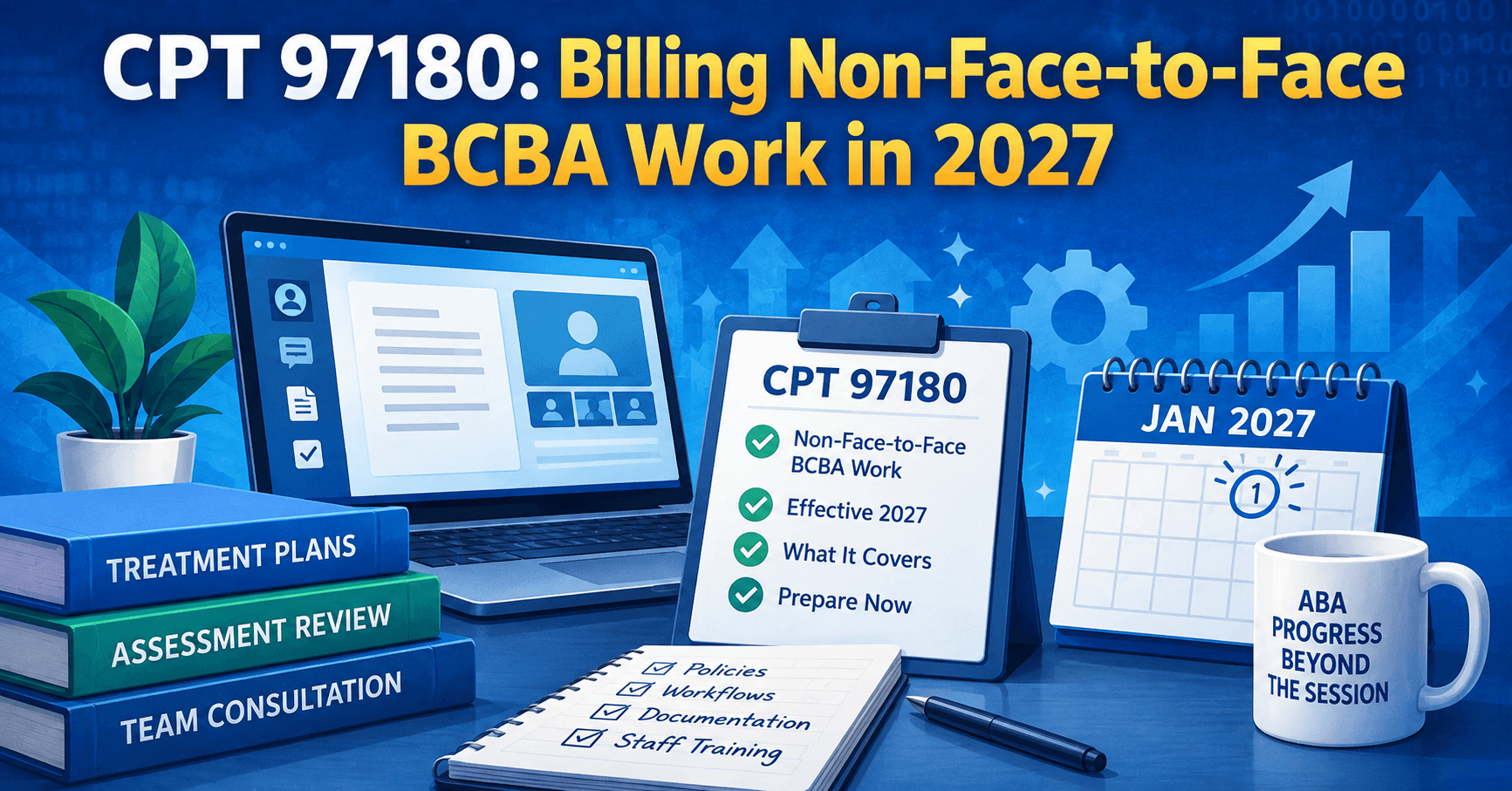
| 97180 | 97X3X | Adaptive behavior non-face-to-face services personally performed by a BCBA or other qualified provider: reviewing data and session notes, modifying targets or protocols, deciding whether further assessment is needed, discharge and transition planning, reviewing revised protocols with technicians, 15-minute units | The most consequential addition. BCBA work that is unbillable today outside 97151 gets its own code. Full guide to 97180 |
The existing set is revised too, according to the code-set summaries published since the release: 97155 is redescribed as direction of a technician plus analysis by the qualified provider (its direct-treatment component moves to 97173), 97156 through 97158 add "with analysis" to their descriptors, and 97152 through 97154 drop the "under the direction of" phrasing. Both Category III codes, 0362T and 0373T, are deleted. The set goes from 10 codes to 14. Exact descriptor wording is AMA copyright and publishes in the 2027 CPT Professional Edition; the paraphrases here are for orientation, not for your charge master.
Comment Period Closed September 14: What to Watch in the November Final Rule
The CMS-1848-P comment period closed on September 14, 2026. The ABA Coding Coalition said it would ask CMS to add the six new codes to the Medicare telehealth list with a permanent designation for 2027. The final rule is expected in November 2026, and these are the four open items that matter for ABA practices:
- Telehealth status of the new codes. CMS proposed keeping 97151 through 97158 on the permanent telehealth list for 2027 but said nothing about the six new codes. Whether 97173 and 97180 land on that list decides whether remote BCBA work under the new codes is Medicare-eligible, and most commercial payers follow the CMS list.
- Valuation. All six new codes and the revised codes carried "C" (carrier-priced) placeholders instead of work RVUs in the proposed rule. CMS proposed extending carrier pricing for adaptive behavior codes through 2027, so there will be no national Medicare rate either way; the question is whether the final rule holds that position.
- Whether the code set survives unchanged. CMS adopts AMA CPT codes as published, so the numbers will not change, but the final rule can still comment on how it expects the codes to be used, and that commentary shapes Medicaid and commercial policy.
- Payer adoption timing. State Medicaid programs and commercial payers publish their own 2027 fee schedules and authorization rules after the final rule. Expect a gap between January 1 and the date your payer actually accepts 97180, and get the effective date in writing before you bill it.
The strategic read has not changed, but it is no longer hypothetical: 97180 exists, and the ABA billing model shifts on January 1, 2027. Indirect BCBA work that practices currently absorb as overhead, or stretch to fit inside 97151, becomes separately billable. Practices that already track indirect clinical time at the task level will be able to bill it on day one. Practices that do not track it will spend 2027 reconstructing it.
What Practices Should Do Now
The numbers are published and the effective date is fixed, so the preparation list is concrete:
- Start tracking indirect BCBA time at the task level now. This is the highest-value preparation available, because of 97180. Log protocol review, data analysis, discharge planning, and technician debriefs as discrete time entries rather than folding them into supervision or absorbing them as overhead. Your Q4 2026 tracking becomes your 2027 baseline and your first authorization request. The 97180 guide has the documentation format.
- Attend one of the ABA Coding Coalition explainer webinars (ABAI on September 21, APBA on September 28, CASP on September 30, 2026) or read their guidance afterward. The Coalition cautioned providers and payers in July against changing EMR systems before the official publication; that publication has now happened, so vendor and payer conversations can start.
- Audit your current documentation practices. New codes come with new documentation requirements, and the harmful-behavior codes add technician-count elements that your notes will need to support. Our documentation requirements by payer breakdown covers what payers are enforcing today.
- Talk to your software vendor, with the code numbers in hand. Your practice management system needs 97148, 97149, 97159, 97160, 97173, and 97180 in its code table, the add-on relationship between 97148/97149 and 97159/97160, and a way to capture non-face-to-face time against 97180 before January 1. Ask for the release date, not a roadmap slot.
- Review payer contracts. When new codes publish, payers set rates, and carrier pricing means those rates are negotiated rather than dictated. Practices that engage early in fee schedule discussions tend to get better rates than those who accept defaults.
Top Claim Denial Reasons (and How to Prevent Them)
Denied claims cost ABA practices more than the lost revenue on the individual claim. Each denial triggers a cycle of investigation, correction, resubmission, and waiting that consumes staff hours and delays cash flow. Here are the most common ABA denial triggers and what to do about each one.
Authorization expired or units exhausted. The authorization ran out before the claim was submitted, or the practice billed more units than the payer approved. Prevention: track remaining authorized units in real-time and set alerts at 80% utilization. Re-authorization requests should go out at least 30 days before the current auth expires.
Wrong or missing modifier. The claim is missing the required credential modifier (HM/HN/HO) or uses the wrong one for the rendering provider. Prevention: build modifier validation into your claims submission workflow. Your billing software should flag claims where the modifier doesn't match the provider's credential on file.
Documentation doesn't support the code. The session note doesn't demonstrate the service described by the CPT code. A BCBA billing 97155 needs notes showing active protocol modification, not just supervision. Prevention: train clinicians on what each code requires in the note. Periodic documentation audits catch patterns before payers do.
Timely filing deadline missed. Commercial payers typically require claims within 90 days; Medicaid programs allow up to 365 days in most states, but some have shorter windows. Prevention: submit claims within 48 hours of the service date. Batch billing at the end of the month creates unnecessary filing risk.
Concurrent billing violation. The practice billed overlapping codes for the same client and time period, and the payer doesn't allow it. Prevention: verify each payer's concurrent billing policy and configure your billing system to flag potential overlaps before submission.
How VGPM automates code validation. VGPM runs pre-submission validation on every claim: code-modifier compatibility, authorization unit availability, rendering provider credentials, and timely-filing windows. The result is a 95%+ clean claim rate and The Hands-Free Billing Engine: the only ABA billing software that runs hands-free on clean claims, closing 85 to 95% of them end to end without manual review.
If your practice is seeing denial rates above 5% on a consistent basis, or if your billing team is spending more time on appeals than on clean claim submission, it may be time to evaluate whether your current billing setup is protecting your revenue or quietly leaking it. Our comparison of in-house vs. outsourced billing models breaks down the real costs and trade-offs, and our ABA claim denial management service details the root-cause triage and payer-specific appeal workflow that keeps preventable denials from repeating.
Code-by-Code Reference: All 10 Active ABA CPT Codes
Each code below carries its own denial pattern and its own 2027 outlook. Jump to the one you're billing.
| Code | Category | Description | Provider | Per Unit |
|---|---|---|---|---|
| 97151 | Assessment | Behavior identification assessment | BCBA | 15 min |
| 97152 | Assessment | Supporting assessment | Technician | 15 min |
| 97153 | Treatment | Adaptive behavior treatment by protocol | Technician | 15 min |
| 97154 | Treatment | Group treatment by protocol | Technician | 15 min |
| 97155 | Treatment | Treatment with protocol modification | BCBA | 15 min |
| 97156 | Treatment | Family or caregiver guidance | BCBA | 15 min |
| 97157 | Treatment | Multiple-family group guidance | BCBA | 15 min |
| 97158 | Treatment | Group treatment with modification | BCBA | 15 min |
| 0362T | Assessment | Team-based assessment (harmful behavior) | Team + BCBA | 15 min |
| 0373T | Treatment | Team-based treatment (harmful behavior) | Team + BCBA | 15 min |
CPT 97151: Behavior Identification Assessment
Billed by a BCBA or other qualified provider in 15-minute units. The only ABA code that covers both face-to-face and non-face-to-face time, including scoring, record review, and treatment-plan writing. Medicare typically caps it at 8 units per day; commercial and Medicaid caps vary. Most common denial: billed without the completed assessment report on file, or units exceeding the authorization. 2027 outlook: revised, and some of the indirect work it currently absorbs may move to the new non-face-to-face code.
CPT 97152: Behavior Identification Supporting Assessment
Billed by a technician working under BCBA direction, 15-minute units, face-to-face time only. Covers structured preference assessments and standardized tools the BCBA designed. Most common denial: indirect technician time billed here (it is not payable), or a missing HM modifier. 2027 outlook: revised.
CPT 97153: Adaptive Behavior Treatment by Protocol
Billed by a technician, 15-minute units, one-on-one and face-to-face. The highest-volume ABA code at nearly every practice. Most common denial: authorization units exhausted, missing HM modifier, or a session note that does not evidence protocol implementation. Increasingly also concurrency denials where it overlaps 97155. 2027 outlook: revised. Watch the Michigan-style documentation duration limits, which cap hours per note rather than per day.
CPT 97154: Group Adaptive Behavior Treatment by Protocol
Billed by a technician for two or more patients, 15-minute units, billed per patient. Most common denial: group size or staffing ratio outside the payer's stated requirement, or billing group and individual treatment in overlapping time. 2027 outlook: revised.
CPT 97155: Adaptive Behavior Treatment with Protocol Modification
Billed by a BCBA or other qualified provider, 15-minute units. May include simultaneous direction of a technician, where the payer allows it. Most common denial: concurrency with 97153, and notes that document supervision rather than active protocol modification. 2027 outlook: revised. Direct provider treatment splits out into new code 97173; 97155 narrows to technician direction plus analysis.
CPT 97156: Family or Caregiver Adaptive Behavior Treatment Guidance
Billed by a BCBA or other qualified provider, 15-minute units, with or without the patient present. The most underbilled code in the set: parent and caregiver training is billable, improves outcomes, and strengthens the clinical case for continued authorization. Most common denial: no documented link between the caregiver session and treatment-plan goals. 2027 outlook: revised, and it remains on the telehealth list in states that narrowed coverage.
CPT 97157: Multiple-Family Group Adaptive Behavior Treatment Guidance
Billed by a BCBA or other qualified provider for two or more families or caregivers, 15-minute units. Most common denial: payer does not cover the multiple-family format at all, which is common enough that you should verify before scheduling a group. 2027 outlook: revised.
CPT 97158: Group Adaptive Behavior Treatment with Protocol Modification
Billed by a BCBA or other qualified provider for two or more patients, 15-minute units. Most common denial: same group-composition and ratio issues as 97154, plus notes that do not show modification for each patient billed. 2027 outlook: revised.
CPT 0362T: Exposure-Based Behavioral Assessment (Team)
A Category III code for assessing severe harmful behavior that requires two or more technicians in a customized environment with the BCBA on-site, 15-minute units. Most common denial: Category III codes carry no assigned relative value and many payers do not cover them at all, so denials here are usually coverage denials rather than coding errors. 2027 outlook: deleted January 1, 2027. New codes 97148 (base) and 97149 (add-on per additional technician) carry the concept forward as permanent Category I codes.
CPT 0373T: Exposure-Based Behavioral Treatment (Team)
The treatment counterpart to 0362T, same team and environment requirements, 15-minute units. Most common denial: coverage, same as 0362T. 2027 outlook: deleted January 1, 2027, with 97159 (base) and 97160 (add-on per additional technician) as the permanent Category I replacement pair.
For authoritative code definitions and updates, refer to the ABA Coding Coalition's billing codes page and the BACB's supervision and credentialing requirements. For denial-code language on your remittance advice, the X12 claim adjustment reason codes are the canonical reference.
Where Medicaid Coverage Comes From
One structural point that explains why state rules vary so much. Federal law requires state Medicaid programs to cover medically necessary ABA for children under EPSDT, the early and periodic screening, diagnostic, and treatment benefit. EPSDT mandates the coverage but leaves each state to define the operational details: rates, unit caps, supervision ratios, telehealth scope, and concurrency. That gap is why a code can be federally listed for telehealth and still be non-covered in your state, and why cross-state practices need per-state billing procedures rather than one national policy.
Update Log
- September 18, 2026 (substantive update): The AMA published the CPT 2027 code set on September 9, so the six new adaptive behavior codes now have numbers: 97148, 97149, 97159, 97160, 97173, 97180. Every passage that described them as confidential until late 2026, or as CMS placeholders 97X1X through 97X6X, was rewritten; the placeholder-to-code mapping is kept in the 2027 table for readers who planned from the July proposed rule. The CMS-1848-P comment period closed September 14, and the "proposed is not final" caveat became a four-item watch list for the November final rule. Two FAQ answers, the short answer, the TL;DR, and the 97155, 0362T, and 0373T outlooks were updated to match. No 2026 code rules changed.
- July 24, 2026: Added the 2027 section built on CMS's proposed CY 2027 fee schedule, the state-by-state concurrent-billing crackdown, and the 2026 telehealth permanence.
Staying Ahead of Billing Changes
ABA billing is getting more complex, not less. The 2027 code overhaul, tightening documentation standards, mid-year concurrency reversals, and state-by-state Medicaid divergence all add operational burden to practices that already have too much on their plates. The practices that protect their revenue are the ones that treat billing compliance as an ongoing discipline, not a set-it-and-forget-it task.
That means regular code audits, proactive authorization tracking, clean documentation habits (the session-note mistakes that trigger denials are a useful place to start), and staying current with payer policy changes. Whether you manage billing with your own team, compare ABA billing software options, use a dedicated ABA billing service, or build your workflows around the right ABA practice management software, the goal is the same: every session you deliver should turn into revenue you collect.