TL;DR (For Practice Owners)
If January was about signals, February was about confirmation.
- ABA Medicaid rate cuts 2026 are expanding across multiple states, quietly tightening margins.
- ABA hour caps 2026 are becoming more consistent and harder to push back on without strong data.
- Documentation scrutiny is increasing, especially around supervision and medical necessity.
- AI is moving from “nice to have” to a real operational advantage.
Payers, regulators, and the broader healthcare system are all moving in the same direction: reduce cost, increase oversight, and expect better data.
Here’s what actually matters right now if you’re running an ABA practice.
Want the full picture? Read our State of ABA Therapy 2026 for market data, workforce trends, billing benchmarks, and outlook for independent practice owners.
Rate Pressure Isn’t Slowing Down
Across several states, Medicaid programs are continuing to adjust reimbursement. In many cases, it’s not labeled as a “cut,” but when you look closer, that’s effectively what’s happening.
Some states are lowering rates on core codes like 97153. Others are holding rates flat while costs (wages, benefits, admin overhead) continue to rise. Either way, margins are getting tighter.
What’s notable this month is that this is no longer isolated. It’s becoming a pattern.
If your model depends on historical rates, it’s probably already under pressure, or about to be.
Hour Caps Are Getting More Predictable, and More Restrictive
Payers are getting more consistent with how they limit hours, which might sound like a good thing, but it’s not necessarily.
Instead of case-by-case variability, we’re seeing clearer patterns:
- Lower approved hours at renewal
- More resistance to increases
- Shorter authorization windows
The underlying shift is this: payers are standardizing utilization control.
That means approvals are less about your individual case and more about fitting into a predefined box.
If you want to push beyond that box, you need strong, clean data that clearly shows progress and necessity. The right ABA practice management software makes it much easier to pull that data together at authorization time.
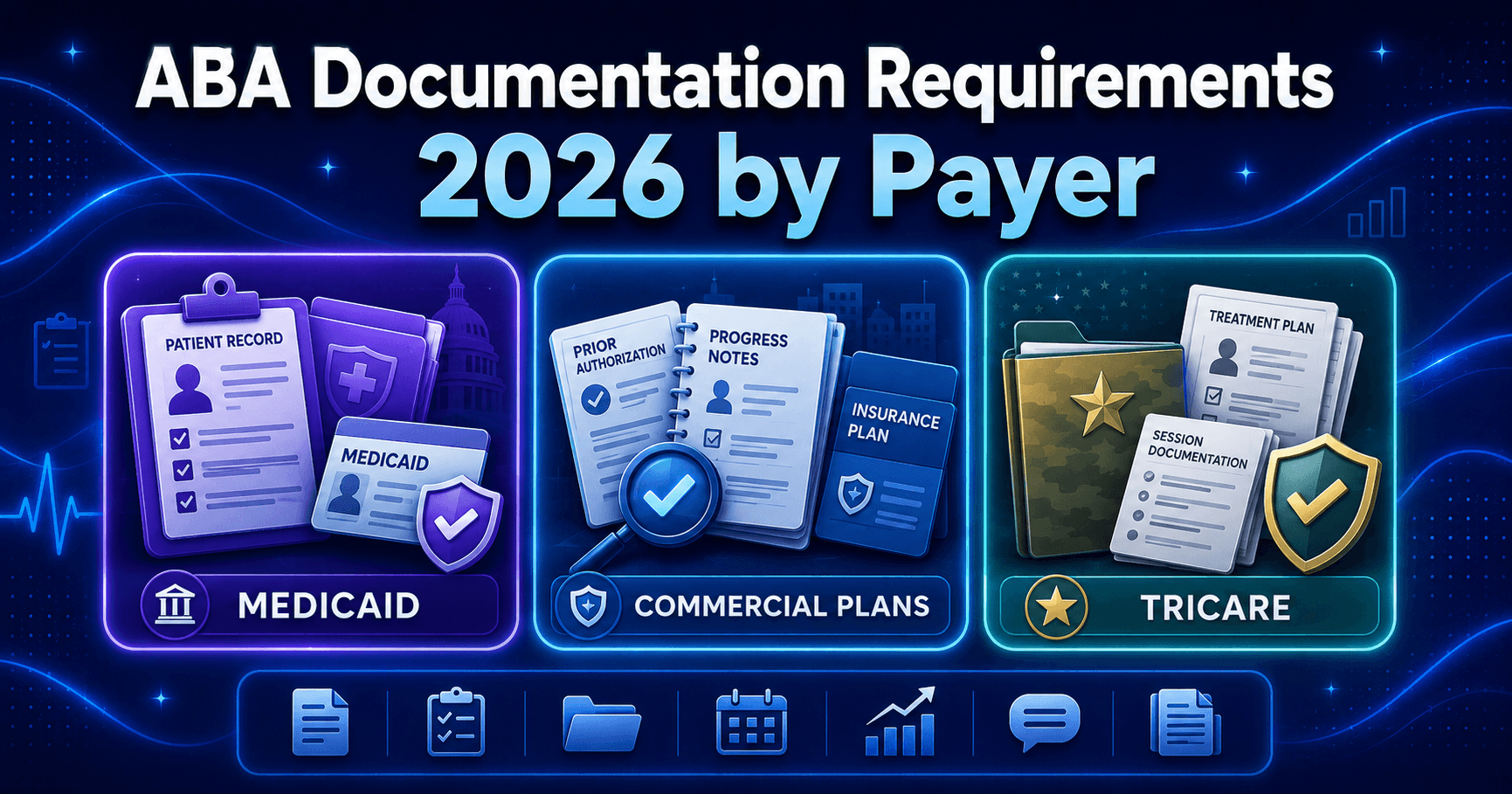
Documentation Is Becoming the Battlefield
This is probably the most important trend to pay attention to.
Audits aren’t new, but what’s changing is how detailed and specific they’re getting.
We’re seeing more focus on:
- Whether supervision (97155) is clearly tied to treatment
- Whether session notes actually support medical necessity
- Whether data aligns with what’s in the treatment plan
It’s less about “do you have documentation” and more about “does your documentation hold up under scrutiny.”
Practices that are even slightly inconsistent here are starting to feel it. The right ABA billing software helps catch issues before submission, and outsourcing to a specialized ABA billing service or revenue cycle management partner can take the pressure off internal teams.
Read more:
- https://www.bcbsm.mibluedaily.com/stories/coverage/strengthening-clinical-documentation-for-aba-services
- https://oig.hhs.gov/documents/audit/10123/A-09-22-02002.pdf
AI Is Quietly Becoming a Real Advantage
This isn’t hype anymore.
More practices are starting to use AI for things like:
- Drafting session notes
- Assisting with treatment planning
- Catching billing or documentation issues before submission
The interesting shift is that it’s not just about saving time. It’s about consistency.
AI is helping standardize outputs across staff, which directly impacts compliance and audit readiness.
Practices that adopt this well are going to operate leaner and cleaner than those that don’t. For a comparison of platforms integrating AI capabilities, see the best ABA practice management software guide.
Efficiency Is Separating the Top Practices
With everything else tightening (rates, hours, audits), the practices that are doing well all have one thing in common: they run tight operations.
They’re not necessarily bigger. They’re just more controlled.
They know:
- Their utilization in real time
- Where cancellations are happening
- How long billing is taking
- Where money is getting stuck
And they act on it quickly.
On the flip side, practices that are still relying on manual processes or “we’ll figure it out later” are starting to feel squeezed. For practices looking to grow through this environment, the ABA Practice Accelerator provides the operational infrastructure to scale without losing control.
This gap is getting wider.
Read more:
- https://www.aha.org/aha-center-health-innovation-market-scan/2024-11-15-mobilizing-data-improve-operational-efficiency
- https://www.netsuite.com/portal/resource/articles/financial-management/operational-efficiency-healthcare.shtml
Final Takeaways
Nothing in February was shocking, but that’s the point.
Everything is reinforcing the same direction:
- Rates are under pressure
- Hours are being controlled
- Documentation needs to be airtight
- Efficiency matters more than ever
And now, increasingly, technology (especially AI) is becoming the lever that determines who adapts and who struggles.
If January was the warning, February is the confirmation.
Related: VGPM ABA Software | ABA Revenue Cycle Management | ABA Practice Accelerator